
Data literacy is workforce literacy
Data literacy is workforce literacy
Most workforce decisions in most organizations are still made without data. Managers hire based on gut feel and reference checks. Executives set headcount targets based on last year’s budget plus adjustments. Retention strategies get built on exit interview data that is often misleading. Onboarding programs run on tradition. Manager promotions happen because someone has been in the role long enough. Compensation gets adjusted based on market rumor and what employees are asking for.
None of this is malicious. It is just how workforce decisions have historically been made. The tools to do it differently did not exist. The infrastructure was not available. And the discipline of using workforce data to inform strategic choices was not something most companies were built to practice.
That has changed in the past several years. And the companies that have built the capability to use workforce data are pulling ahead of the ones that have not.
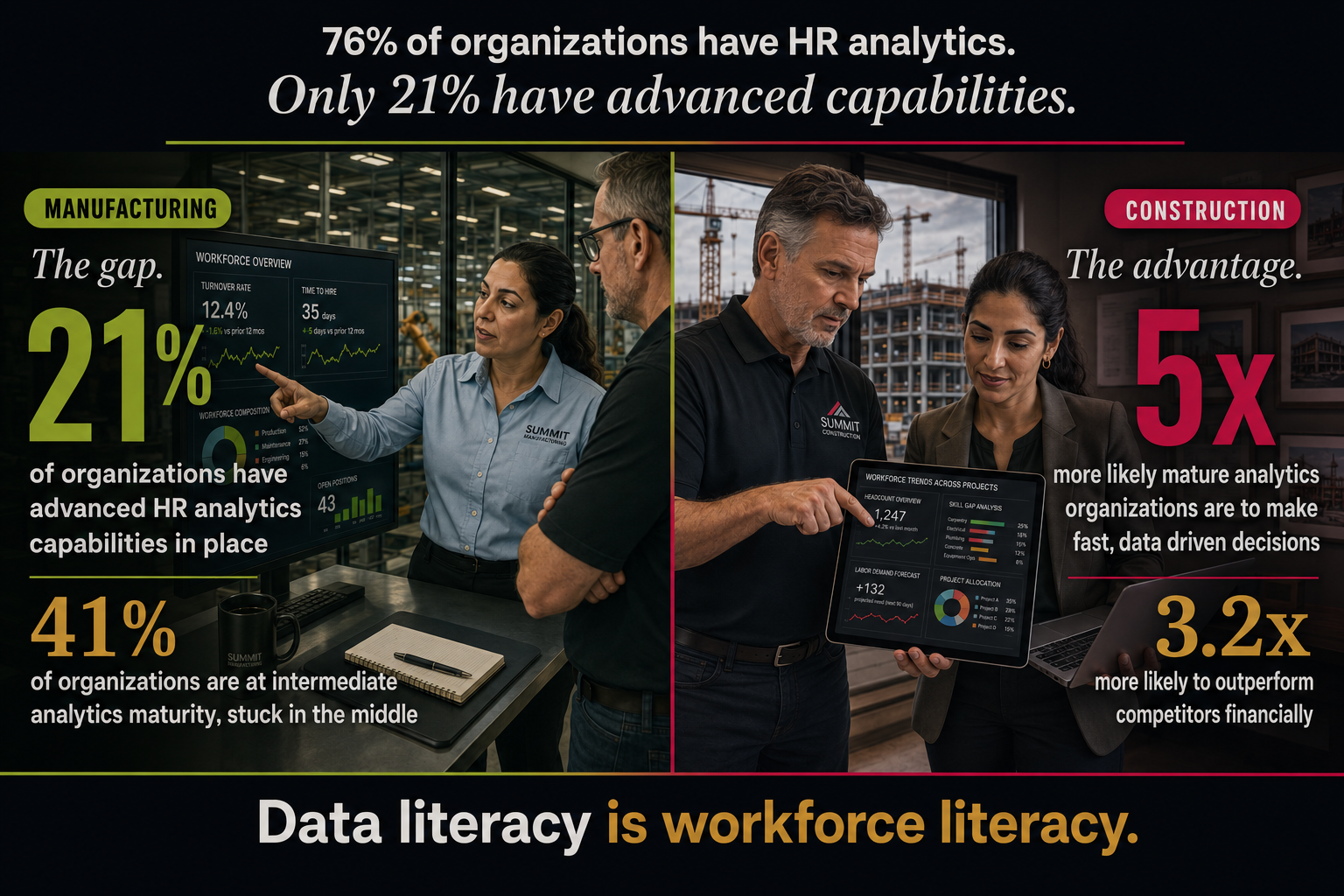
The data on this is direct. According to the Proklamate 2026 State of Analytics in Human Resources report, 76 percent of organizations now have some form of HR analytics in place, but only 21 percent have advanced analytics capabilities. Roughly 41 percent sit at intermediate maturity, capable of running basic reports but not equipped to use workforce data as a strategic decision making tool. Second Talent research also found that 74 percent of organizations face data quality challenges that limit the value of the analytics they already have. The infrastructure exists. The maturity to use it is uneven at best.
The gap in outcomes is significant. Organizations with mature people analytics practices are 5 times more likely to act constructively on data insights than those without, according to research from HR.com and Insight222. Companies with mature HR analytics programs are 3.2 times more likely to outperform competitors financially, based on the same data set. Organizations using AI powered predictive analytics for turnover show 41 percent better talent decisions and 32 percent faster problem resolution than those relying on traditional approaches. These are not marginal differences.
They are structural differences in workforce performance driven by whether or not the company can actually use the data it has.
This pattern connects directly to the workforce data we have explored across the recent arc. The safety and retention post showed that companies with strong safety data see turnover drop dramatically. The technology adoption gap post showed that companies pairing tools with workforce readiness capture the productivity gains that companies buying tools alone do not. The productivity paradox post showed that decades of technology investment have not translated into aggregate productivity growth. The through line across all three is that data, when actually used, changes outcomes. And when it is not used, the outcomes stagnate regardless of how much investment goes in.
The workforce data literacy gap is not evenly distributed. Certain industries have moved faster than others. Financial services, technology, and consumer packaged goods have generally led adoption. Manufacturing and construction have lagged, driven by a mix of legacy systems, distributed workforces, inconsistent data collection, and workforce practices that have historically prioritized operational metrics over people metrics. The gap is not insurmountable, but closing it requires deliberate investment.
The organizations that are building genuine workforce data literacy tend to share a few characteristics. They invest in HR technology that integrates cleanly with operational and financial systems, so workforce data can be viewed alongside the business outcomes it drives. They build data literacy across HR business partners and frontline managers, not just within a small analytics team, so insights can inform decisions at the point they are made. They integrate workforce analytics into planning cycles rather than treating them as periodic reports, so people data is part of every quarterly and annual review. They start with a small set of high leverage metrics rather than trying to measure everything, so leaders can actually engage with what the data says. And they treat workforce data as a strategic asset with the same rigor they apply to financial data, including governance, quality controls, and defined ownership.
There is also a candid observation worth making. Some HR leaders resist workforce analytics because they fear it will reduce the role of judgment and experience. The opposite is closer to the truth. Data literacy is what makes judgment better, not what replaces it. A hiring manager who knows the historical data on which sourcing channels produce the strongest hires makes better sourcing decisions. A leader who knows the turnover pattern by tenure makes better retention investments. A workforce planner who knows the actual time to fill by role type makes better capacity decisions. Data does not remove judgment. It informs it.
The strategic implication for manufacturing and construction leaders is significant. In an industry environment defined by labor shortages, rising replacement costs, accelerating technology adoption, and competitive pressure on productivity, workforce data literacy is one of the highest ROI capabilities a company can build. It is also one of the most transferable. Data literacy that starts in HR can spread to operations, safety, quality, and eventually to executive decision making. Companies that build the capability early will compound the advantage over years.
The larger arc of the past several months of this series has pointed at a common theme. The workforce challenges facing manufacturing and construction are real, structural, and
unlikely to resolve on their own. The good news is that most of them are solvable, and the strategies that work are well documented. The obstacle is rarely the strategy. It is the ability to see the data clearly, make decisions from it, and act with the discipline required to sustain the effort.
At Organa, this is core to how we work with our clients. We help organizations build the workforce data capabilities that support better hiring, retention, and workforce planning decisions. We help leaders see what the data is telling them about their workforce, connect those insights to the operational and financial outcomes of the business, and build the discipline required to act on what they learn.
Data literacy is workforce literacy. In the environment ahead, the companies that build it will be the ones that pull away.
Sources: Proklamate 2026 State of Analytics in HR Report; HR.com State of People Analytics 2024 to 2026; Second Talent HR Analytics Statistics 2026; Insight222 People Analytics Research 2025 to 2026; AIHR Workforce Analytics Trends 2026; IBM Institute for Business Value Predictive HR Analytics Research; TriNet 2025 State of the Workplace Survey; Phenom People Analytics Implementation Research