
Four generations. One workforce. One challenge.
Four Generations. One Workforce. One challenge
For the first time at the scale we are seeing today, four generations are working side by side across American manufacturing and construction. Boomers who built decades of expertise. Gen X leaders carrying the operational weight.
Millennials now moving into executive and senior management roles. And Gen Z arriving in bigger numbers than most of the industry expected. Each group brings its own set of expectations, communication preferences, work habits, and definitions of what makes a job worth staying in.
The challenge is not generational diversity itself. The challenge is that most management, communication, and workforce practices were not built for a workforce this spread out, and the companies that have not updated them are starting to feel the difference.
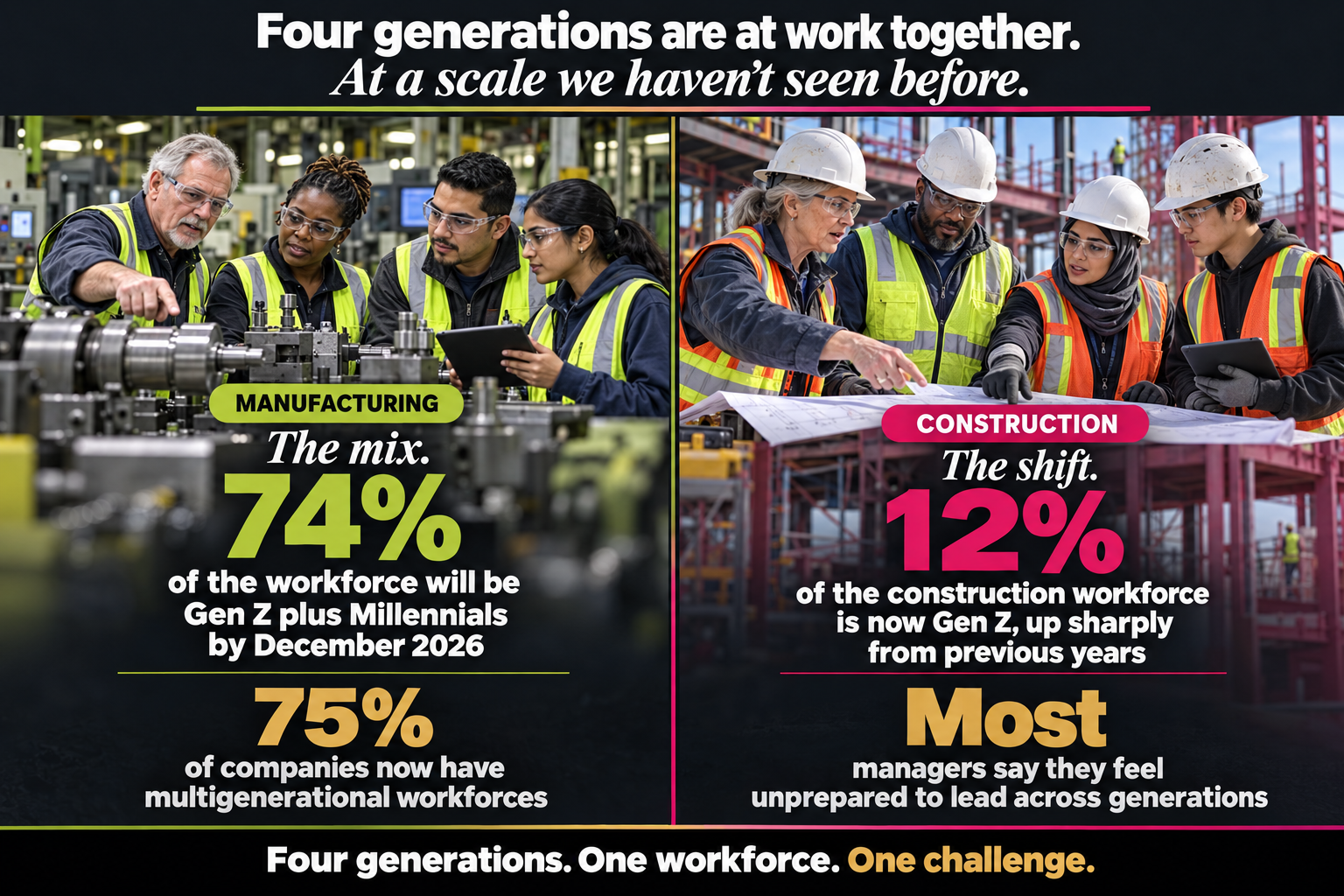
The data confirms the pace. By December 2026, Gen Z and Millennials combined will represent approximately 74 percent of the US workforce. Gen Z alone has grown to roughly 12 percent of the construction workforce, up sharply from previous years, and the share continues to climb. Nearly 75 percent of companies now have multigenerational workforces, according to CIPD research summarized by People Management. And yet, the same research found that most managers report feeling unprepared to lead across generations, with limited formal training, coaching, or support for navigating the differences.
The friction shows up in ordinary ways. A Boomer superintendent and a Gen Z apprentice have different expectations about feedback, pace, and how authority is communicated. A Gen X manager who built her career on long hours and in person presence may struggle to interpret the ways a Millennial direct report measures commitment. A Gen Z new hire who grew up with instant digital communication may read silence from a manager as disinterest, when the manager intends to show respect for the worker’s focus. None of these differences are character flaws. They are predictable patterns, and companies that understand them lead better and keep more of their workforce.
There is a strategic lens worth putting on this. The organizations that get the most value from a multigenerational workforce treat it as a strength, not a complication. The experienced generations carry institutional knowledge, operational judgment, and relationships that would be impossible to replace. The emerging generations bring new technical fluency, fresh perspective, and the openness to question practices that may have outlived their usefulness. When those contributions are flowing in both directions, the workforce becomes more resilient and more innovative. When they are not, the organization loses on both ends.
The practices that make this work are consistent and well documented. Companies that lead across generations invest in manager training that explicitly addresses generational differences, not as stereotypes but as patterns.
They structure mentorship programs that run both ways, with experienced workers teaching craft and judgment while younger workers teach new tools and approaches. They adjust communication expectations to meet workers where they are, which often means offering multiple channels rather than mandating one. They design career pathways that are visible and tangible, which Gen Z in particular has been clear about expecting. They treat recognition as a leadership practice rather than an HR program. And they build feedback cadences that are more frequent and less formal than the annual review model that has dominated most industries for decades.
This connects directly to several of the workforce themes we have explored across this series. The middle manager bottleneck post showed that managers account for 70 percent of the variance in team engagement, and the manager relationship is often where generational tension plays out most directly. The Gen Z in the trades post showed that this generation is choosing manufacturing and construction in significant numbers, but that interest only converts to long term retention when the receiving experience is built for them. The internal mobility post showed that career pathways matter more to younger workers than most companies account for. The pattern across all three is that generational dynamics are not a soft topic. They are the material of modern workforce management.
There is also a candid observation worth making. Some leaders in manufacturing and construction remain skeptical of generational frameworks, viewing them as oversimplifications or as excuses for performance differences.
The skepticism is understandable. Generational labels can be used lazily, and no leader wants to manage a team based on stereotypes. The pattern we see with clients is that the leaders who dismiss generational differences entirely tend to miss predictable workforce signals, and the leaders who treat generational labels as absolute tend to miss the individual. The strongest leaders use generational data as a starting point for understanding, not an endpoint. They stay curious about the people on their teams, and they adjust their practices as the workforce in front of them changes.
The strategic implication for manufacturing and construction leaders is clear. The workforce composition of the industry is shifting rapidly, and the practices that produced strong retention and engagement a decade ago are not sufficient on their own anymore. Companies that update their management practices, communication norms, and development pathways for the current generational mix will build durable advantages over companies that continue to run the playbook that worked when the workforce looked different.
At Organa, this is core to the conversations we have with our clients. We help organizations understand the generational composition of their workforce today and project how it will shift over the next several years. We work with leaders on the management practices that build engagement and retention across generations. And we help companies design the hiring, onboarding, and development programs that make the full generational mix a strength rather than a management challenge.
Four generations. One workforce. One challenge. The companies that treat it as an opportunity will be the ones that pull ahead.
Sources: CIPD Research via People Management 2025; HR C Suite Workforce Composition Projections 2026; BuilderMuse 2026 Gen Z Construction Workforce Report; Marsh McLennan Four Generations in the Workplace Analysis; iHire 2025 Multi Generational Workforce Report; Employer Branding News Generations in the Workplace 2026 Analysis