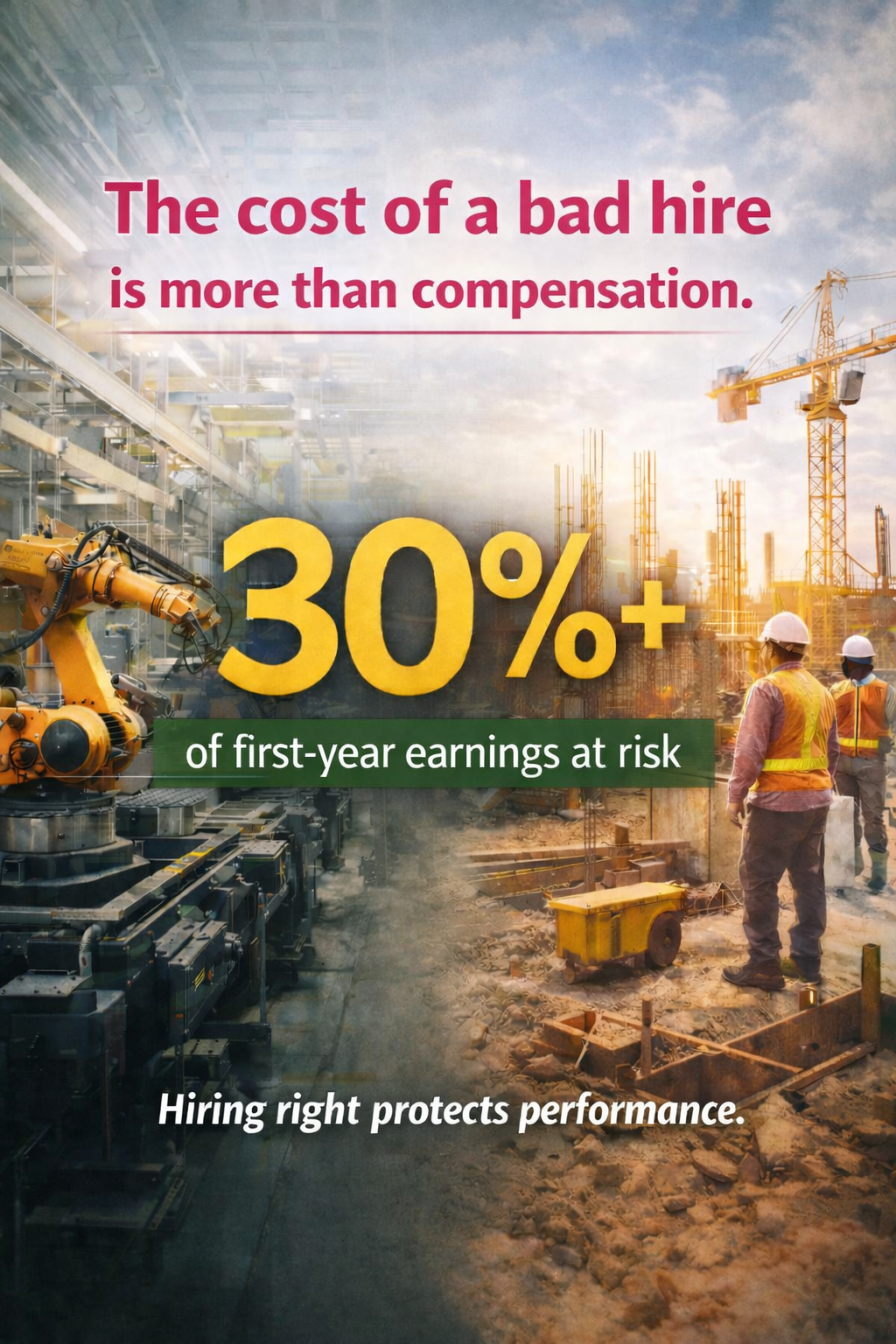
The U.S. Department of Labor estimates the cost of a bad hire at up to 30 percent of that employee’s first year earnings. For most leaders, that number tells only part of the story.
When you bring on the wrong person in a reliability leadership role, the cost is not measured in salary. It is measured in unplanned downtime, in deferred decisions, in the time other leaders spend correcting course. When the wrong project manager joins a construction firm, the cost shows up in slipped milestones, strained client relationships, and crews that lose confidence in the plan.
The financial estimate captures the visible damage. The operational damage usually exceeds it.
In manufacturing and construction especially, where roles touch production, safety, and project execution, a misaligned hire ripples through the organization in ways that are difficult to undo. Production gets disrupted. Projects get delayed. Safety exposure increases. Leadership attention shifts from strategic priorities to incident management.
Different industries. Same consequence.
One pattern stands out across the operations we work with most closely. The leaders who consistently hire well are not the fastest ones. They are the most prepared. They have defined what success looks like in the role before the first candidate is screened. They have aligned their interview team on the criteria that actually predict performance. They have built consensus on the trade offs they are willing to make and the ones they are not.
That preparation is what allows them to move quickly when the right candidate appears. Speed without preparation produces fast bad hires. Preparation without speed produces lost candidates. The discipline is doing both.
At Organa, we help organizations build the underlying structure that supports better hiring decisions. Not interview scripts or scoring rubrics for their own sake, but the kind of clarity that lets a leadership team look at a candidate and know, with confidence, whether this is the person who will move the organization forward.
The cost of a bad hire is real. The cost of a slow process that loses good ones is just as real. The organizations that take both seriously are the ones building stronger teams.
Sources: U.S. Department of Labor (Cost of a Bad Hire Estimate); SHRM Hiring & Retention Research