In most manufacturing and construction operations, labor accounts for roughly 70 percent of total operating costs. That is not a number you can engineer your way around. What you can change is how that labor performs and at what cost.
When workforce gaps appear, the most common response is to push existing teams harder. Add overtime. Stretch the schedule. Ask the same people to cover more ground. It works in the short term. It almost always backfires in the long term.
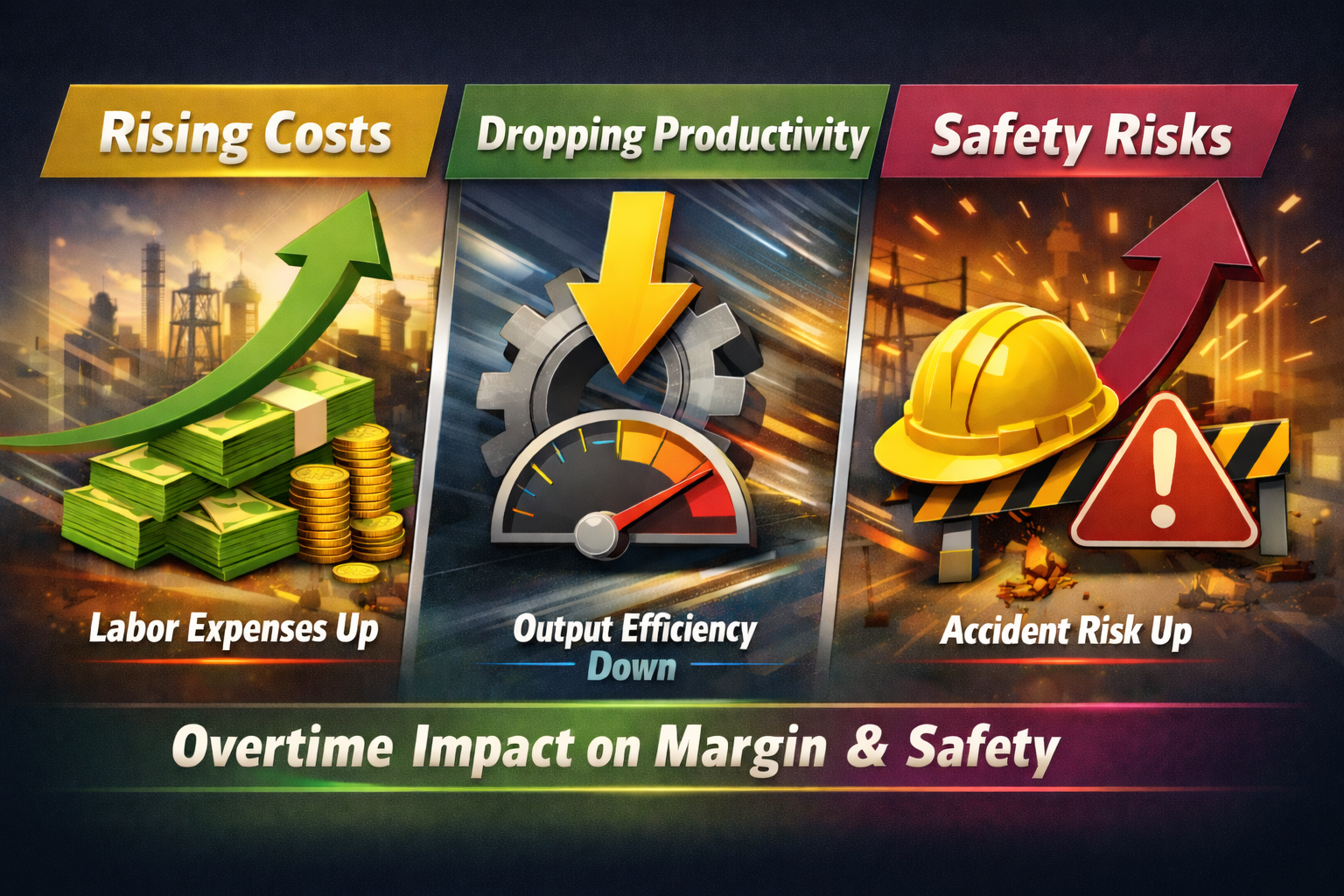
Research from Circadian’s workforce studies shows that a 10 percent increase in overtime correlates with about a 2.4 percent drop in productivity. The National Safety Council attributes 13 percent of workplace injuries to fatigue. These are not edge cases. They are the predictable result of running operations on borrowed capacity.
Different industries. Same operational pattern.
On any plant floor or job site, the difference between a team operating with structural support and one holding the line through individual heroics becomes visible within an hour. Heroics are powerful. They are also unsustainable. The operations that produce reliable results year after year are the ones that do not depend on extraordinary effort to deliver ordinary results.
The cost of running short is not a single line item. It shows up in payroll first, then in productivity, then in safety, then in turnover. By the time it shows up in turnover, the cost has compounded.
For executives reading the monthly P&L, the temptation is to see overtime as a flexibility lever. And in the right doses, it is. But sustained overtime, month after month, is not a flexibility play. It is a hidden tax on margin, performance, and the people who make the operation work.
At Organa, we help leaders build workforce strategies that hold up under pressure. Not just plans that look good on paper, but practices that protect both performance and the teams who deliver it.
The strongest operations are not the ones with the lowest labor costs. They are the ones with the most stable labor performance. There is a meaningful difference between the two.
Sources: Paycor (Labor Cost Analysis); Circadian Workforce Research (Overtime & Productivity); National Safety Council (Fatigue & Injury Risk)