
The talent you need is already in the building
The talent you need is already in the building
The conversation around workforce shortages in manufacturing and construction tends to focus outward. Where will the next generation of skilled trades workers come from? How do we compete with companies offering more money? What pipeline programs will close the gap? All important questions. And all of them overlook one of the most accessible answers in workforce strategy.
A significant portion of the talent organizations need is already on the payroll. The question is whether the company is investing in moving them, or watching them leave.
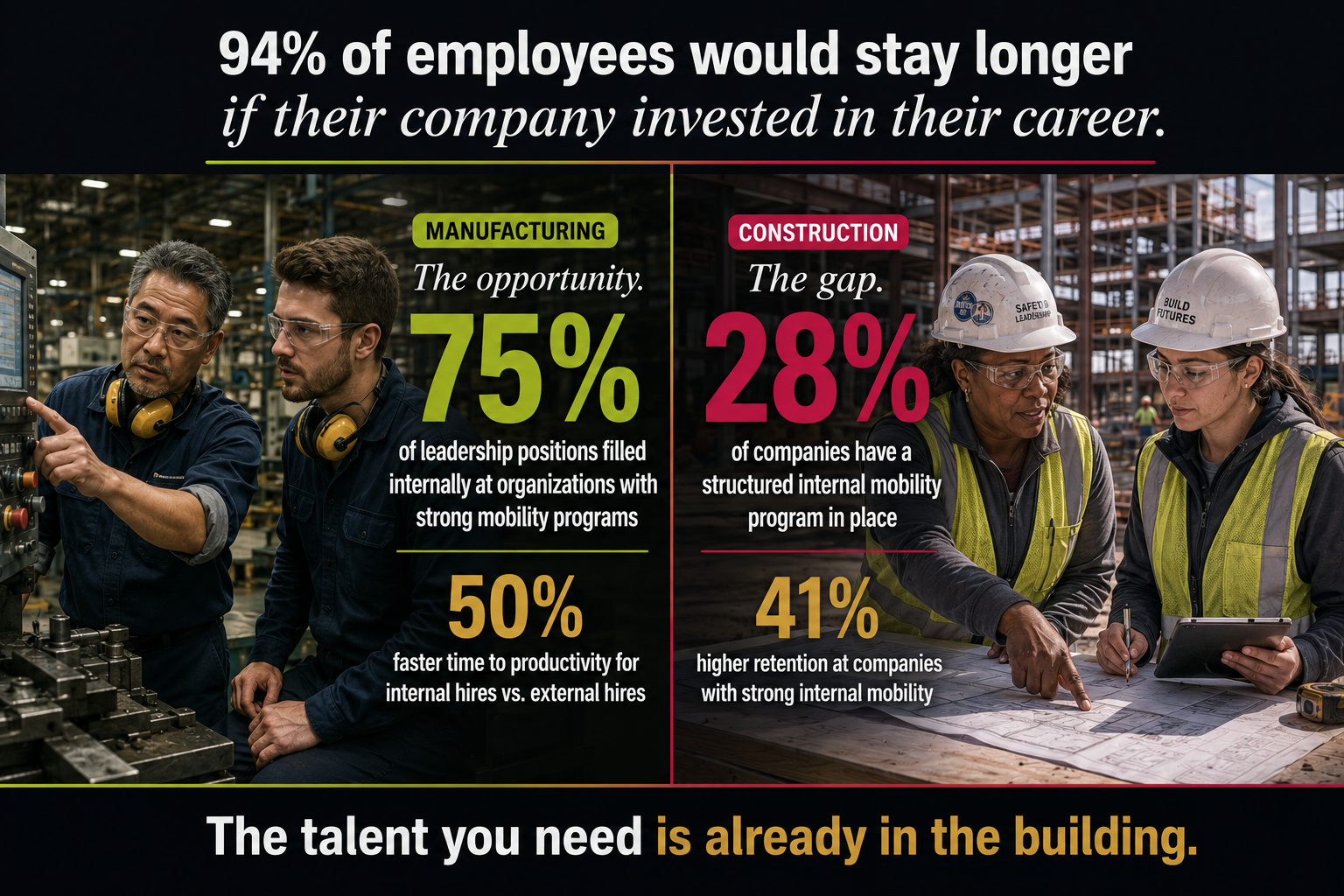
The data on internal mobility is striking. According to LinkedIn research, 94 percent of employees say they would stay longer at a company that invests in their career development. Organizations with strong internal mobility programs fill 75 percent of leadership positions from within, achieve 41 percent higher retention rates, and see internal hires reach full productivity in roughly 3 months versus 6 months for external hires. SHRM research indicates that internal hiring reduces total cost per hire by 30 percent or more, while building the kind of institutional knowledge that compounds over time.
Despite all of that, only 28 percent of companies have a structured internal mobility program in place. The talent strategy with the strongest data behind it remains one of the least adopted.
There is a connection worth pulling forward to the broader workforce arc we have been exploring. The first 90 days are where retention is decided. Stay interviews are how managers surface what is keeping people engaged or pushing them out. Internal mobility is what gives the most engaged employees somewhere to grow. These three practices are not separate initiatives. They are the same workforce strategy expressed at different points in the employee lifecycle.
In our work with manufacturing and construction leaders, we see the same pattern repeatedly. The organizations losing skilled workers fastest are usually the ones that have built strong recruiting funnels and weak internal pathways. They invest heavily in finding people. They invest very little in developing the people they already have. And then they spend the next year recruiting again because the employees with the most potential leave for organizations that will.
The companies retaining and developing talent reliably look different. They map out career pathways that include lateral moves, cross functional projects, and skill expansions, not just vertical promotions. They build visibility into internal opportunities, so employees actually
know what is available without having to ask. They train managers to identify and develop internal talent rather than hoard it. They tie compensation and recognition to development progress, not just years of service. And they measure internal mobility outcomes with the same rigor they apply to external hiring metrics.
There is also a structural reality worth naming. Manufacturing turnover has approached 40 percent in recent years according to Bureau of Labor Statistics data, with production roles often experiencing 30 to 38 percent churn. Construction sees similar volatility in many craft positions. In environments like that, every internal promotion is a retention win, every lateral move is institutional knowledge preserved, and every employee given a path forward is one less requisition open for the next quarter.
The strategic implication is straightforward. External recruiting will always be part of workforce strategy. But for organizations facing structural labor shortages, the most accessible source of skilled talent is often the workforce already inside the company. The companies that build deliberate internal mobility programs are not just retaining better. They are reducing recruiting costs, accelerating productivity, and building the kind of leadership bench that allows the business to scale without constantly starting from scratch.
This week marks the close of a three week series focused on what happens after the hire. The first 90 days protect retention at the start. Stay interviews protect it through tenure. Internal mobility protects it by giving people somewhere to grow. Together, these three practices form one of the highest leverage workforce strategies available to manufacturing and construction leaders today.
At Organa, this is the work we lead alongside our clients. We help organizations design internal mobility frameworks that work for the realities of skilled trades and shop floor environments, build manager practices that develop internal talent rather than block it, and connect mobility data to retention outcomes that protect the workforce already in place.
The talent you need is already in the building. The only question is whether the strategy is built to keep them there.
Sources: LinkedIn Workplace Learning Report; SHRM Internal Hiring Research; Gartner Talent Mobility Insights; HR.com Talent Mobility Programs 2025; Ignite HCM Internal Mobility Research; Bureau of Labor Statistics Manufacturing Turnover Data; Align HCM Talent Mobility Analysis