
The workforce strategy with a 93 percent retention rate
The workforce strategy with a 93 percent retention rate
Manufacturing and construction continue to face some of the deepest labor shortages in the country. Pipelines are thin, retirements are accelerating, and competition for skilled workers is escalating year over year. Most of the workforce strategy conversation focuses on what is broken. There is one strategy that is working, and the data behind it is hard to ignore.
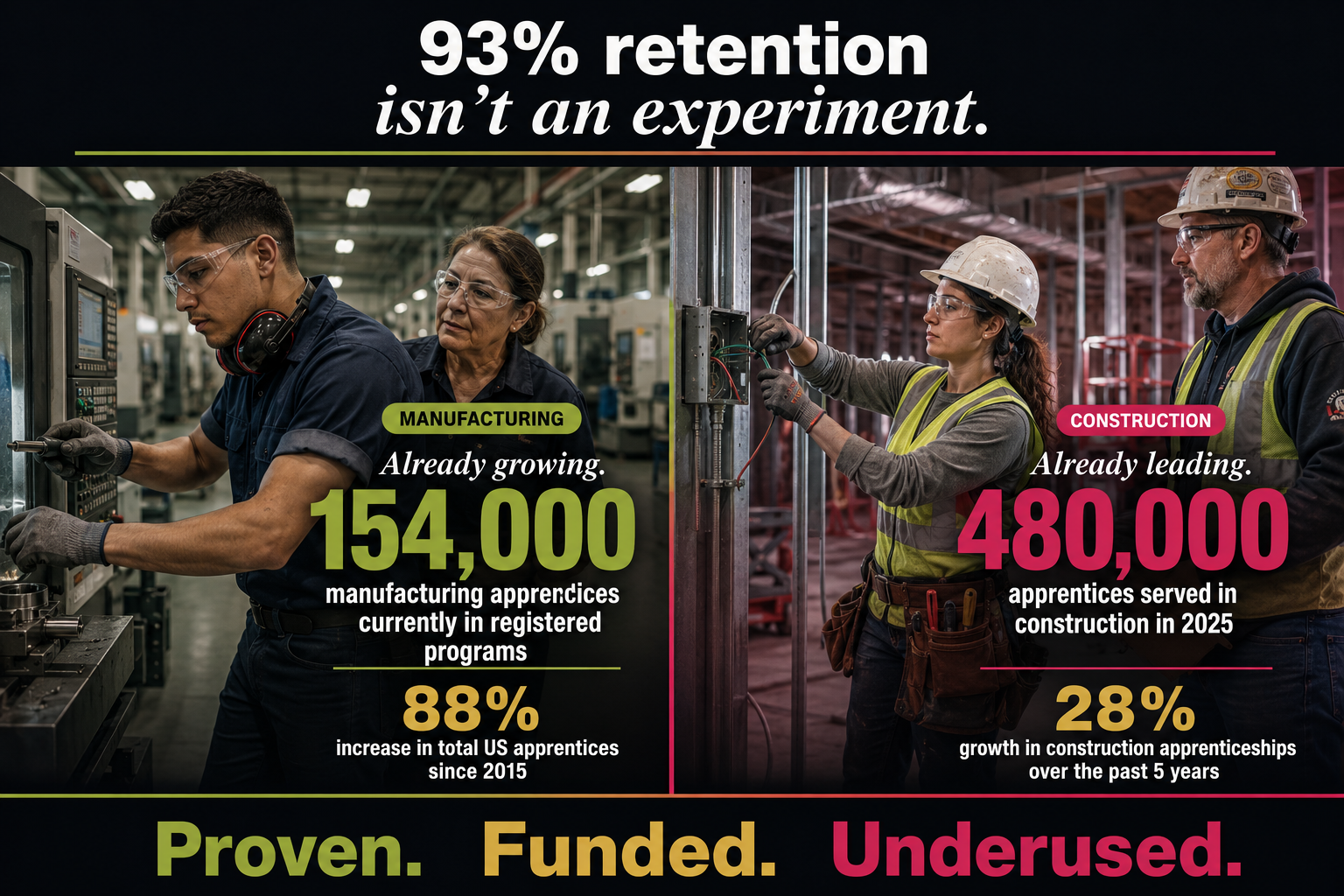
Registered Apprenticeship Programs in the United States have grown from approximately 360,000 active apprentices in 2015 to nearly 940,000 by fiscal year 2024. That is an 88 percent increase in a decade, with construction leading the way at more than 480,000 apprentices served in 2025 alone and manufacturing accounting for another 154,000. The numbers reflect a broader shift in how employers are responding to skilled labor shortages. The companies investing in apprenticeships are not waiting for the talent pipeline to fix itself. They are building it.
The outcomes data is the part that should stop every workforce leader.
Apprenticeship programs deliver an estimated 93 percent employee retention rate after completion. The typical employer reports a 44 percent return on investment. And 95 percent of apprentices earn at least 15 dollars per hour when they complete their program, with 92 percent able to cover basic living expenses on those wages. These are not aspirational benchmarks. They are observed outcomes from federally tracked programs, validated by the Department of Labor and reinforced by GAO reporting.
For comparison, the broader workforce sees turnover rates that exceed 25 percent annually in many manufacturing and construction roles. The cost of replacing a single skilled worker can range from 50 to 200 percent of their annual salary. Against that backdrop, a 93 percent retention rate is not a marginal improvement. It is a structurally different outcome.
So why are apprenticeships still underused?
Most of the resistance traces back to perception rather than performance. Apprenticeships are often viewed as a long term investment with uncertain payoff, when in reality they pay back faster than most external recruiting strategies. They are sometimes seen as administratively heavy, when in practice many states and federal programs have streamlined the registration process significantly over the past five years. And they are still associated primarily with skilled trades and construction, even though the model now spans more than 1,200 occupations and 175 industries.
The companies running successful apprenticeship programs share a few characteristics. They treat apprenticeship as a recruiting strategy, not a community engagement initiative. They use programs like the Department of Defense SkillBridge initiative and Heroes MAKE America to connect with transitioning veterans, both of which are well aligned to apprenticeship pathways. They partner with community colleges, trade schools, and regional workforce boards to share training costs and infrastructure. And they measure apprenticeship outcomes against the same workforce metrics they use for traditional hires, including retention, time to productivity, and total cost per hire.
There is also a funding tailwind worth noting. Federal investment in apprenticeship programs reached approximately 200 million dollars annually in 2025, roughly doubling the previous baseline. Many states offer additional tax credits, training subsidies, and direct grants for employers that register new apprentices. The cost barrier that historically slowed apprenticeship adoption is meaningfully smaller than it was five years ago.
The strategic implication is straightforward. Manufacturing and construction need to build a workforce, not just compete for one. Apprenticeships are the proven model for doing that, with the retention data, the ROI data, and the funding infrastructure to support it. The organizations that recognize this and invest accordingly will have a structural advantage over those that continue treating apprenticeships as an alternative to “real” hiring rather than a core part of the strategy.
At Organa, this is the work we lead alongside our clients. We help organizations evaluate where apprenticeship programs fit into their workforce strategy, connect with the partners and programs that streamline implementation, and build hiring practices that integrate apprentices into the broader recruiting funnel.
Proven. Funded. Underused. The workforce strategy that solves the labor shortage is already on the shelf. The question is whether the organization is ready to pick it up.
Sources: U.S. Department of Labor Employment and Training Administration; U.S. Government Accountability Office Report GAO-25-107040 (April 2025); Apprenticeship.gov Industry Data; HIGH5 Apprenticeship Data US 2025 Report; Center for American Progress Apprenticeship Research; Department of Defense SkillBridge Program