
Transparency isn’t just compliance. It’s a recruiting advantage.
Transparency isn’t just compliance. It’s a recruiting advantage.
A quiet shift has taken place in American hiring over the last few years. Candidates have decided, independent of regulation and ahead of most employer practices, that salary ranges are a prerequisite for engagement. Not a nice to have. Not a question to ask later in the process. A prerequisite. And companies that have not caught up to that shift are losing applicants before they ever reach the inbox.
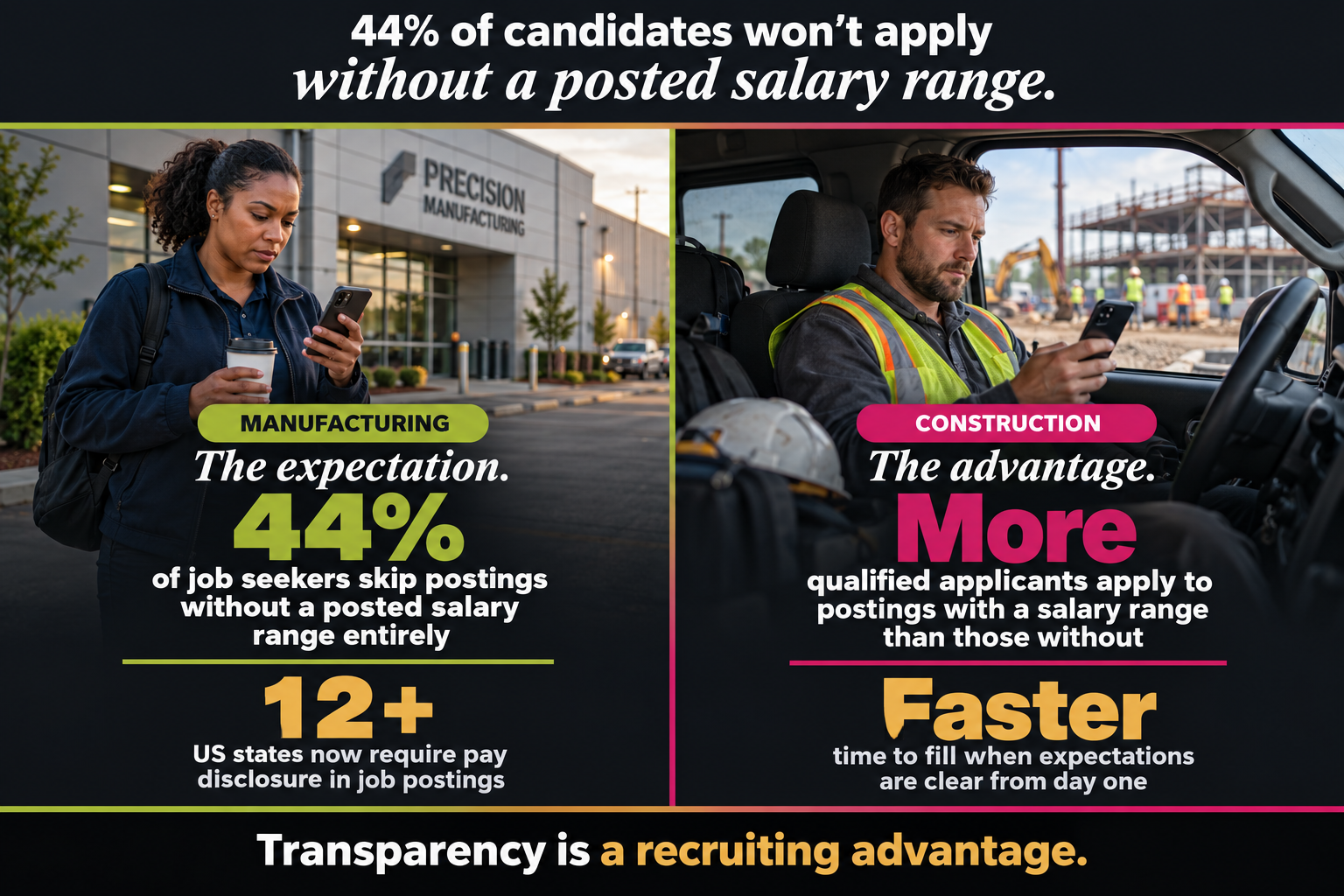
The data is direct. A 2026 Patriot Software survey found that 44 percent of job seekers will not apply to a role without a posted salary range. Separate research from Pin, published in the 2026 Applicant Pool Study, found that job postings with salary ranges attract significantly more qualified applicants than postings without. ZipRecruiter economic research tracking the rise in pay transparency has found that candidates engage faster, offer acceptance rates improve, and time to fill drops when expectations around compensation are clear from the start of the process.
The regulatory backdrop is also moving quickly. More than a dozen US states now have active pay transparency laws requiring employers to disclose salary ranges in job postings, with additional states and major cities adding requirements each legislative session. California, Colorado, New York, Washington, Illinois, Maryland, Massachusetts, Minnesota, New Jersey, and others have all passed laws of varying scope. Enforcement is uneven, but the direction is consistent, and employers operating across state lines are increasingly moving to post ranges on all postings to simplify compliance.
The regulatory story is important, but it is only half of what is actually happening. The more consequential shift is that candidate expectations have moved faster than the law. In most sectors, candidates now expect salary ranges whether a state requires them or not. Companies that post ranges voluntarily are capturing a larger share of qualified applicants, filling roles faster, and reducing the back and forth that used to characterize the early stages of hiring. Companies that do not are quietly losing ground, often without realizing why.
For manufacturing and construction, where candidates often juggle multiple offers in a tight market, the implications are significant. A skilled electrician, machinist, or project manager evaluating two postings will almost always choose to engage with the one that is transparent about compensation. The time cost of applying to a role that may not even pay what the candidate is looking for is a real friction that pay transparency removes. When the range is posted, the candidate self selects based on their expectations, and the applicants who do apply are more likely to be a genuine fit.
There is also a workforce quality effect worth naming. Transparent pay ranges tend to filter out applicants who are significantly misaligned on compensation while attracting candidates who are already in the band the employer wants to hire within. That improves the applicant pool at the top of the funnel, which improves time to interview, time to offer, and ultimately time to fill. The 2026 joint Harvard Business Review and Korn Ferry study on employer value propositions found that companies with clearly articulated and visible compensation expectations attracted candidates with 38 percent higher average first year performance ratings than companies relying on vague posting language.
There is a candid observation worth making. Some leaders remain reluctant to post pay ranges because of concerns about internal equity, competitive signaling, or losing negotiating leverage. These concerns are understandable, but the data suggests they are often overstated. Internal equity is best managed through consistent pay practices rather than information control, since employees increasingly share pay information with each other regardless of what the employer prefers. Competitive signaling cuts both ways, and companies that pay competitively often benefit when their ranges are visible. Negotiating leverage based on information asymmetry has shrunk significantly as pay transparency has spread, and most candidates now walk into negotiations with a clear sense of market rate from Glassdoor, Levels, Payscale, and conversations with peers.
The practices that get the most value from pay transparency are consistent.
Companies lead with realistic ranges that reflect what they are actually willing to pay for the role, not ranges padded on either end to seem flexible. They explain how the range reflects experience, certifications, and location where relevant. They train hiring managers and recruiters to speak to compensation with the same comfort they would speak to the responsibilities of the role. They audit their internal pay practices to ensure the ranges they post are defensible internally. And they treat compensation as part of the broader employer brand, not as a sensitive topic to be managed around.
This connects to several earlier themes in this series. The employer branding post showed that candidates evaluate reputation before salary, and transparent compensation is one of the strongest signals of a trustworthy employer. The candidate experience post showed that friction in the application process is a leading cause of qualified candidates dropping out, and lack of pay information is one of the most consistent sources of friction. The two way ghosting post showed that trust between candidates and employers has eroded in both directions, and pay transparency is one of the fastest ways to rebuild it from the employer side.
The strategic implication for manufacturing and construction leaders is clear. Pay transparency is now a baseline expectation for a growing share of the candidate market, and the companies that embrace it are seeing measurable recruiting advantages. The companies that resist it will continue to lose qualified applicants to employers who have adopted the practice, often without ever learning why the applicant pool thinned.
At Organa, this is a conversation we have with clients regularly. We help organizations build pay transparency practices that reflect the realities of their industry, defend their compensation structures internally, and connect transparency to broader workforce strategy. The goal is not transparency for its own sake. It is a hiring practice that produces better candidates, faster fills, and stronger retention.
Transparency isn’t just compliance. It’s a recruiting advantage. The companies that treat it that way will be the ones that win the applicant volume war before the interview even starts.
Sources: Patriot Software 2026 Job Seeker Pay Transparency Survey; Pin 2026 Salary Range Disclosure Applicant Pool Study; ZipRecruiter Economic Research on Pay Transparency Trends; SixFifty Pay Transparency Laws by State 2026; Kelly Services Pay Transparency Compliance Guide 2026; Harvard Business Review Analytic Services and Korn Ferry Joint Study 2026