When manufacturers measure productivity, they typically look at output, downtime, and throughput. When construction firms measure performance, they look at schedule, budget, and quality. Both should add one more lens to the dashboard. Workforce capacity.
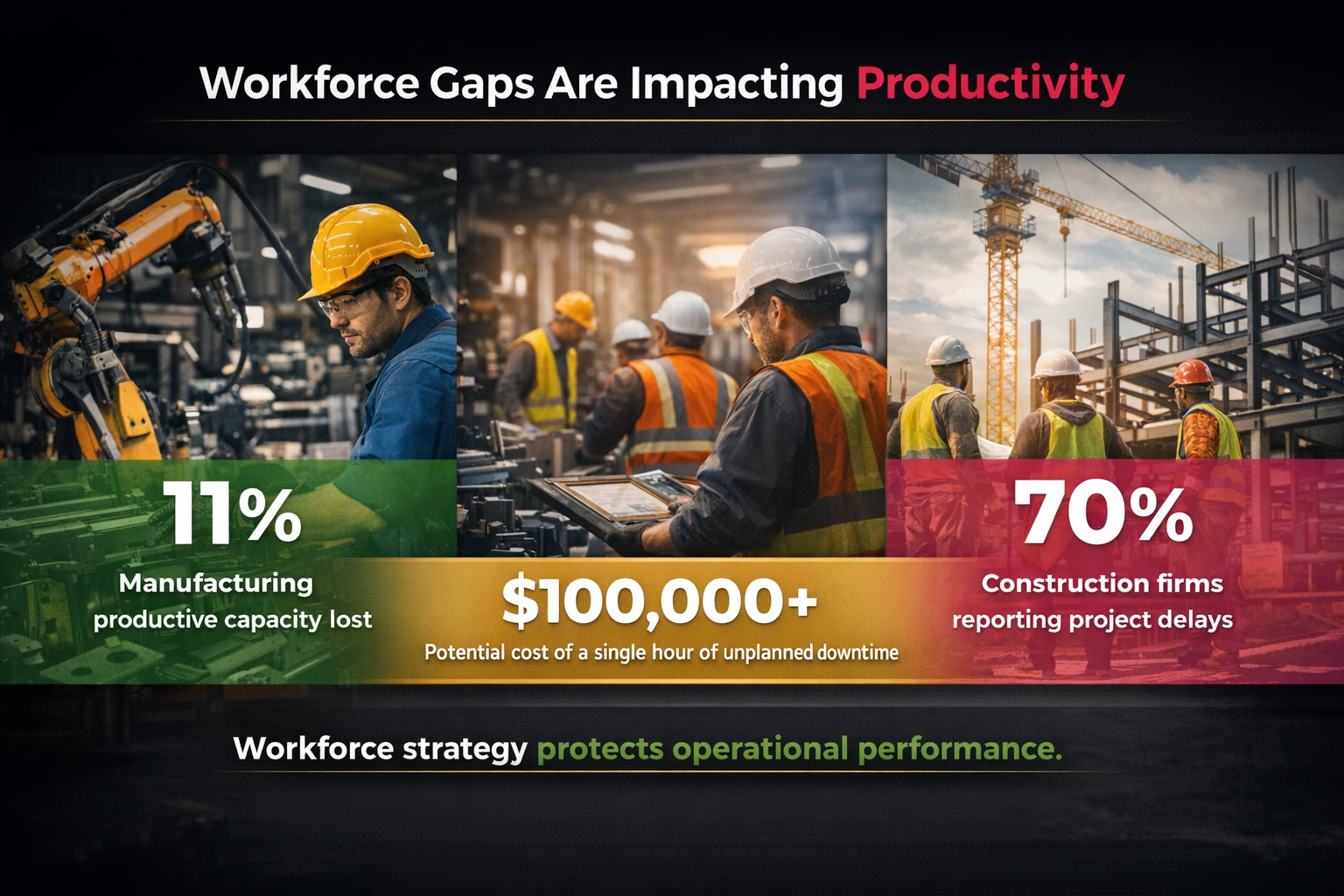
Manufacturers are losing an estimated 11 percent of productive capacity due to workforce shortages and skills gaps. In construction, nearly 70 percent of firms report project delays tied directly to workforce constraints. In many operations, a single hour of unplanned downtime can cost tens of thousands of dollars. In some environments, the figure exceeds $100,000 per hour.
These are not edge cases. They are the operational reality across most of the industry today.
Different industries. Same reality.
Workforce strategy is not just about filling roles. It is about protecting performance.
We have watched a plant lose hundreds of thousands of dollars in a quarter not because of equipment failure, but because the technician roster was short by two people for three months. The line ran. The output happened. But it happened with more rework, more incidents, and more recovery time than it should have. The cost was not visible in any single report. It was distributed across a dozen smaller line items.
That is how workforce gaps express themselves in operations. Quietly. Through margin compression rather than dramatic failure. Through projects that finish a few weeks late rather than getting cancelled. Through customer commitments that get met but with diminished quality.
The leaders who have started treating workforce as a performance lever talk about it the way they talk about inventory or maintenance. With specifics. With measurement. With the assumption that a gap in this area produces a measurable outcome elsewhere.
At Organa, we help operations leaders connect workforce strategy to performance outcomes that matter in the business. Not generic engagement metrics, but the operational indicators that move alongside workforce stability.
If your organization measures everything except the workforce capacity required to produce it, you are missing one of the most important inputs in the equation. The good news is, once you start looking for it, the connections become clear quickly.
Sources: Deloitte; Associated General Contractors of America; industry operations and downtime estimates