
Contract talent is a workforce strategy, not a compromise
Contract talent is a workforce strategy, not a compromise
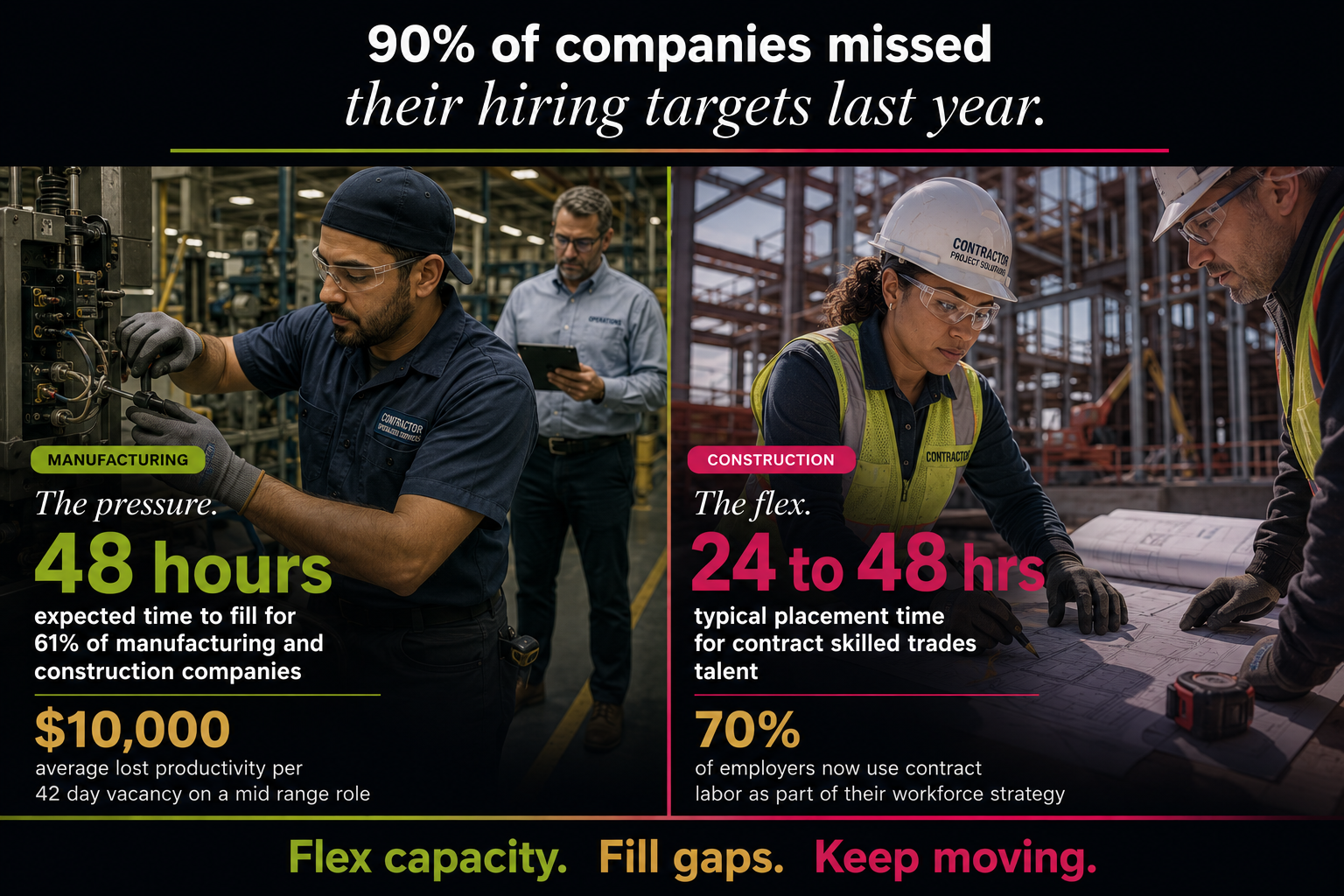
In manufacturing and construction, workload rarely moves in a straight line. Project cycles compress and expand. Seasonal demand shifts. Skilled trades shortages create capacity pressure that no amount of permanent hiring can fully absorb. And when the labor market is tight enough that 90 percent of companies failed to meet their hiring targets in 2025, the traditional playbook of hiring permanent staff to match every workforce need is running into its own limits.
Contract talent is often treated as a backup plan when direct hiring falls short. The data suggests it is worth taking more seriously than that. Deployed strategically, contract talent is one of the most flexible and reliable ways for manufacturing and construction leaders to match workforce capacity to actual workload, without overcommitting to permanent headcount that may not be sustainable through the next cycle.
The pressure is real. The Everee 2025 Manufacturing and Construction Workforce Study found that 61 percent of manufacturing, logistics, and construction companies now expect roles to be filled within 48 hours. 13 percent expect same day placement. Traditional direct hire recruiting rarely delivers on those timelines. The average time to hire in 2025 was 63.5 days across all industries. In manufacturing, it was 30.7 days. Neither of those pace with the operational demand most companies now face when a key role opens unexpectedly or a project ramps up.
The cost of moving slowly is measurable. A single 42 day vacancy on a $60,000 mid range salaried role represents approximately $10,000 in lost or redistributed productivity, before recruiting costs are counted. For higher paying skilled trades roles, the number climbs. For safety critical roles, the cost expands into schedule delays, overtime, and elevated incident risk. Every day a critical position stays open, the team absorbing the missing work operates above sustainable capacity, and the cost compounds.
Contract talent addresses this pressure in a way permanent hiring cannot. Skilled contract workers can typically be sourced, screened, and placed within 24 to 48 hours through a specialized recruiter partnership. The engagement is time bound, which means both the employer and the worker know what to expect. The commitment matches the actual scope of work, which means capacity aligns with workload without inflating fixed labor cost. And when the project ends or the workload eases, the arrangement concludes cleanly, without the disruption or expense of a reduction in force.
This is why over 70 percent of employers now use contract labor as part of their workforce strategy. It is not a fallback. It is a flexible capacity tool that responds to how modern manufacturing and construction actually operate.
The use cases go well beyond emergency coverage. Contract talent is deployed for project based ramps, when a major initiative requires more skilled hands for a defined period. It is used to bridge capacity through peak seasons, particularly in construction where weather and project timing drive workload. It is brought in to provide specialized expertise for defined periods, such as commissioning new equipment, executing a facility expansion, or managing a compliance transition. It is used to maintain output during permanent recruiting cycles, so operations do not slow while the search for a direct hire continues. And it is used to test whether an ongoing need is truly permanent before committing to a full time headcount decision.
None of these use cases require the contract worker to be positioned as second tier. The organizations that use contract talent well tend to share a few practices. They treat contract workers with the same professionalism, safety training, and access to resources that permanent employees receive. They pay competitively and transparently about the structure of the engagement. They provide clear scope and expectations upfront, so the contract worker can perform effectively from day one. They give feedback throughout the engagement, not just at the end. And they build long term relationships with the recruiter partners who source their contract talent, so the pipeline is ready when it is needed.
There is a candid observation worth making. Some hiring leaders remain skeptical of contract labor based on assumptions that it signals lower skill, lower commitment, or higher risk. The data suggests those assumptions are outdated. In manufacturing and construction, skilled trades professionals often choose contract work for the variety, the higher earning potential on specific projects, or the ability to work on their own schedule. Many of the strongest workers in the field spend at least part of their careers in contract engagements. Treating contract work as a lesser category of employment often means overlooking some of the most experienced and available talent in the market.
There is also a broader strategic point. In a labor market this tight, workforce flexibility is itself a competitive advantage. Companies that can rapidly flex capacity up or down through skilled contract talent have more strategic optionality than companies that rely exclusively on permanent hiring. They can bid more aggressively on projects because they know they can staff them. They can respond to unexpected demand without capacity crises. They can protect their permanent workforce from unsustainable overtime during ramps. And they can concentrate their direct hiring on the roles that most benefit from long term investment.
At Organa, this is core to how we work with our clients. Contract talent is one of the primary ways we help manufacturing and construction leaders match workforce capacity to workload. We source skilled contract workers who deliver from day one, structure engagements that work for both the employer and the worker, and build the long term partnerships that make contract talent available when it is needed rather than after the pressure is already at peak. Our clients use contract talent because it works, not because direct hire fell through.
Flex capacity. Fill gaps. Keep moving. In a workforce environment this dynamic, that flexibility is not a compromise on workforce strategy. It is the workforce strategy.
Sources: GoodTime Hiring Trends Report 2025; Employ 2025 Time to Fill Data; Everee 2025 Manufacturing and Construction Workforce Study; American Staffing Association Contract Workforce Data; SHRM Cost of Vacancy Analysis; Staffing Industry Analysts Industry Report