
Your brand is talking. Whether you are or not.
This is a subtitle for your new post
There is a version of your company that exists in the minds of candidates before you ever meet them. It is built out of Glassdoor reviews, conversations at industry events, comments from former employees on LinkedIn, and what current employees tell their friends about what it is like to work there. It shapes who applies to your open positions, who accepts your offers, and who quietly decides your company is not worth their time.
This is your employer brand. And the data suggests it is doing significantly more work in the hiring process than most leaders realize.
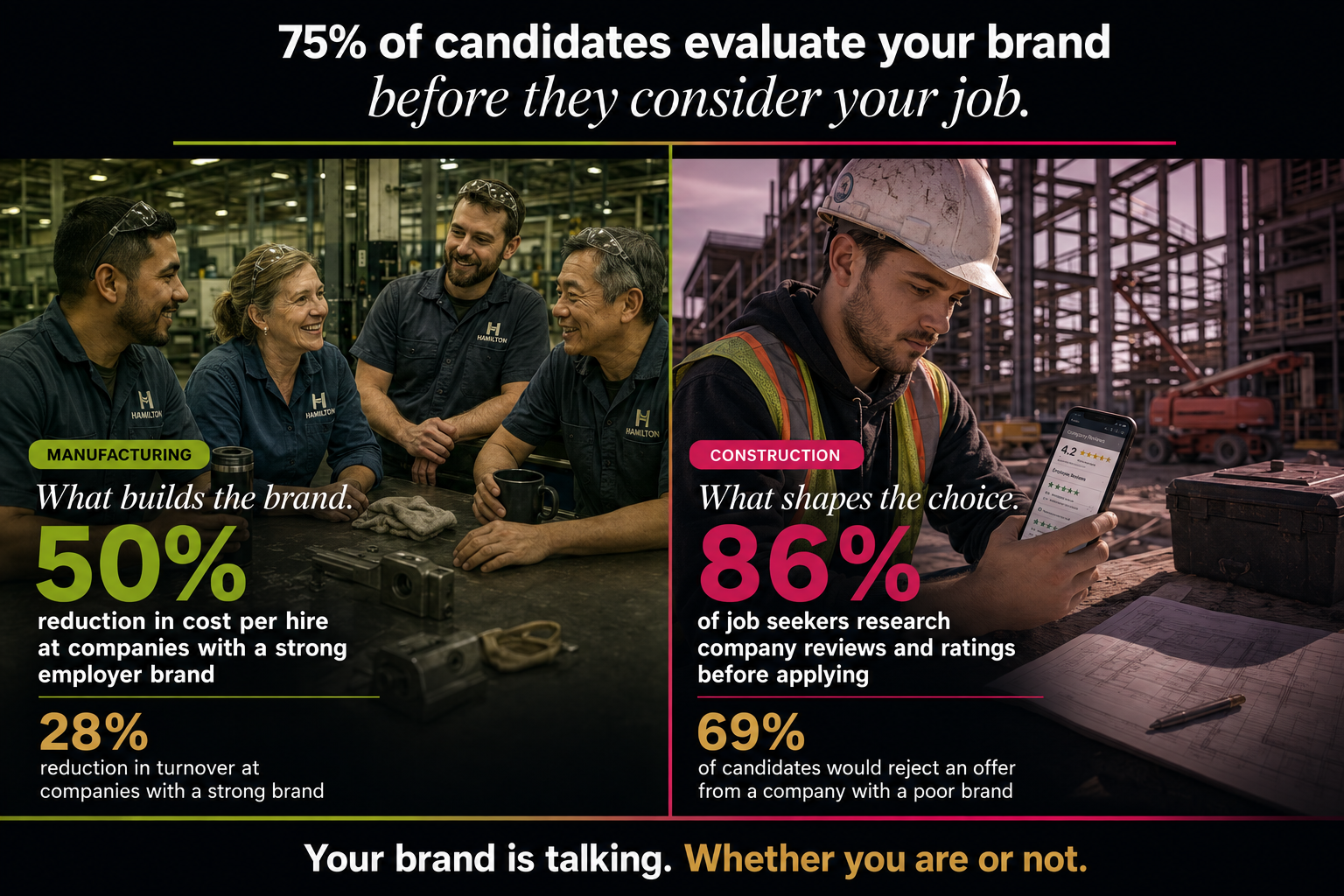
According to LinkedIn research, 75 percent of candidates now evaluate an employer’s brand before they consider salary or job title. 86 percent of job seekers research company reviews and ratings before applying, based on Glassdoor data. And 69 percent would reject a job offer from a company with a poor employer brand, according to Randstad. In a labor market where skilled trades workers can choose between multiple offers within their region, that reputation is often the deciding factor before the recruiter ever picks up the phone.
The business impact is significant. Companies with strong employer brands see approximately 50 percent lower cost per hire, according to Universum. They see a 28 percent reduction in turnover. They receive 2.6 times more organic applications than bottom quartile peers, based on a 2026 Universum Global study tracking 500 Fortune 1000 companies. And they save an average of 1.2 million dollars per year per 1,000 hires in recruitment marketing spend, because reputation does the work that paid advertising would otherwise have to do.
The pattern shows up in candidate quality too. A 2026 joint study by Harvard Business Review Analytic Services and Korn Ferry analyzed 320 companies across 14 industries and found that organizations with clearly articulated and externally visible employer value propositions attracted candidates with 38 percent higher average performance ratings in their first year, and reduced mis hire rates by 43 percent compared to companies relying solely on job description based recruitment.
Employer brand is not a marketing initiative. It is a workforce strategy multiplier.
The challenge for manufacturing and construction leaders is that employer brand in these industries has historically been built the same way it has been managed. Informally, over years, largely through word of mouth. That worked well when the workforce was more stable, more local, and more homogenous. It works less well now. Candidates are researching online. Employees are posting on social media. Former employees are leaving reviews. Younger workers are asking questions their parents and grandparents never thought to ask. And the reputation that surfaces on Google or Glassdoor is often the reputation that determines whether the strongest candidates apply.
The organizations that are getting this right tend to share a few characteristics. They monitor their employer brand actively, not defensively. They track Glassdoor scores, review responses, and social sentiment the way they track any other workforce metric. They invest in the internal experience first, because a believable employer brand is built on what employees actually experience, not on what a careers page claims. They train hiring managers to represent the role honestly, because misalignment between the promise and the reality is one of the most reliable ways to create early attrition. They give employees platforms to share their experience authentically, because employee voices are consistently rated more credible than employer statements. And they respond to negative feedback with specificity and follow through, because a company that visibly listens is a company that candidates trust.
They also measure the results. Application volume by role and location. Offer acceptance rates. First year retention. Employee referral participation. These are the metrics that reveal whether employer brand is actually working, and they are the metrics that most companies do not connect back to workforce strategy.
There is also a candid observation worth making. In manufacturing and construction, employer brand often gets treated as a soft topic that lives outside the operational conversations where workforce decisions are made. The data suggests that is a strategic mistake. The reputation of your company as a place to work is now one of the strongest predictors of your ability to attract, hire, and keep the workforce you need. Leaders who treat employer brand as operational strategy will build durable advantages over leaders who treat it as HR communications.
At Organa, this is the work we lead alongside our clients. We help organizations understand what their employer brand is actually saying in the market, align that brand with the internal experience that supports it, and build the practices that turn reputation into a measurable recruiting and retention advantage.
Your brand is talking. Whether you are or not. The question is whether the story is one that helps you attract the workforce you need, or one that quietly costs you the workforce you already have.
Sources: LinkedIn Employer Branding Research 2025; Glassdoor Employer Branding Statistics; Randstad Employer Brand Research; Universum Global Employer Branding Study 2026; Harvard Business Review Analytic Services and Korn Ferry Joint Study 2026; Michael Page Employer Branding Report