The most common reason hiring decisions go wrong is not that the right candidate was not in the pool. It is that the hiring team did not agree on what “right” actually meant.
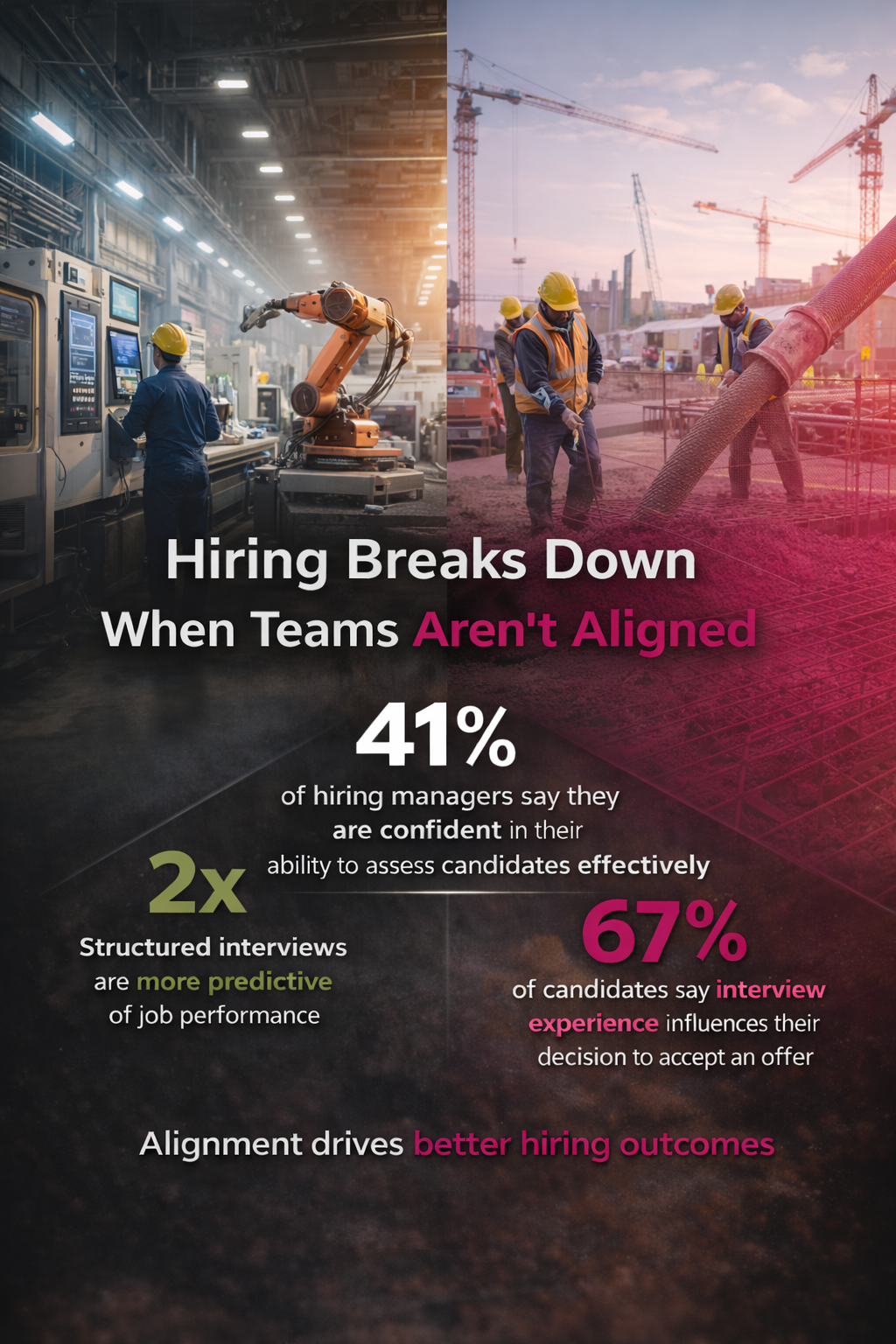
Only 41 percent of hiring managers say they are confident in their ability to assess candidates effectively. Structured interviews are about twice as predictive of job performance as unstructured approaches, yet many organizations still rely on inconsistent evaluation methods. Sixty seven percent of candidates say their interview experience plays a major role in whether they accept an offer.
Different industries. Same reality.
The challenge is not finding the right person. It is building alignment on what “right” looks like before interviews begin.
When that alignment does not exist, predictable things happen. Strong candidates are evaluated against five different invisible standards held by five different interviewers. Decisions take longer because the team is trying to reconcile competing priorities after the fact. Hiring outcomes become inconsistent because the inputs were never consistent.
We have watched a hiring team turn down a strong candidate because two interviewers were evaluating for different things and neither realized it. One was looking for technical depth. The other was looking for collaborative leadership. The candidate had both, but neither interviewer saw what the other one valued, so the conversation never landed on either strength.
That is not an interview problem. That is an alignment problem.
The teams that hire well consistently start every search the same way. They get specific about what success in the role requires. They assign each interviewer a focused area to evaluate. They build a shared vocabulary for what they are looking for. And they make sure the people in the decision making room are not measuring the same person against five different rubrics.
Preparing a future ready workforce means doing this work before the first candidate is screened, not after the first round wraps.
At Organa, we help organizations build that alignment up front. Because once it is in place, the rest of the hiring process becomes faster, more consistent, and more confident. Not because anyone is moving harder, but because the team finally agrees on what they are trying to find.
Sources: LinkedIn Talent Insights; SHRM; Talent Board Candidate Experience Research