
Safety isn't just compliance. It's retention
Safety isn't just compliance. It's retention
The conversation about the American workforce feels more urgent than it has in a long time. With manufacturing shortages, construction backlogs, and retention pressures across nearly every skilled trade, the question of what actually keeps people in these industries has never mattered more.
The data points to something that most workforce strategy conversations still underweight.
Safety is one of the single strongest retention drivers in manufacturing and construction. It is also one of the most consistently underestimated. In most organizations, safety is positioned as a compliance function, an insurance line item, or a required training block. The evidence suggests it is significantly more than that. Companies with genuinely strong safety cultures see turnover reductions that would be unattainable through pay increases or benefits improvements alone. The reason is simple. Workers stay where they feel protected. Workers leave where they do not.
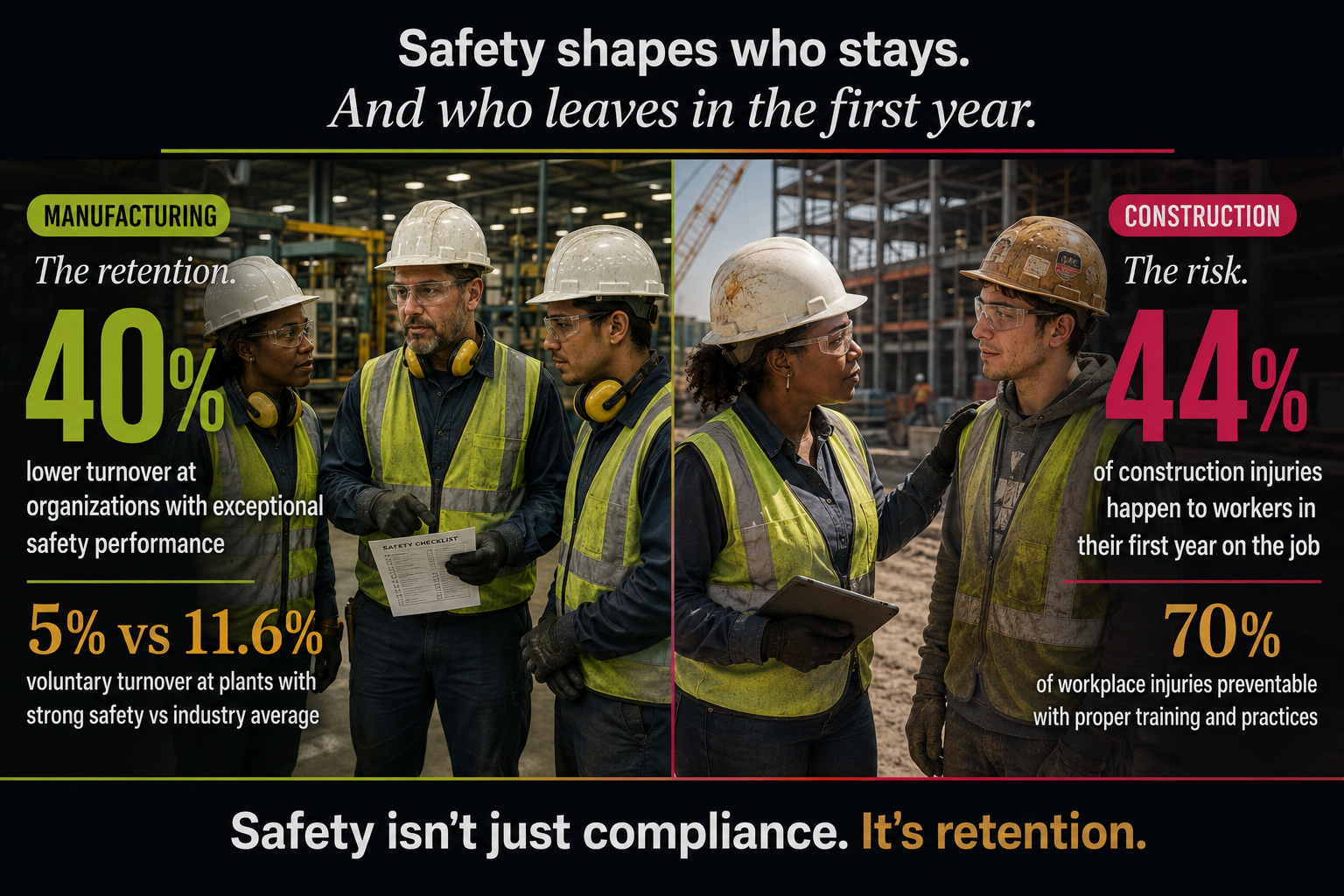
The numbers make the case directly. Voxel AI research compiling industry data across skilled trades operations found that organizations achieving exceptional safety performance report 40 percent lower turnover than industry averages. World Economic Forum reporting from 2025 documented a food packaging manufacturer whose plants using real time safety monitoring recorded a 44 percent lower total recordable injury rate, with voluntary turnover dropping to 5 percent compared to the 11.6 percent industry average. Berg Compliance Solutions, drawing on more than two decades of manufacturer engagements, has documented turnover reductions of up to 35 percent at companies that made safety excellence a strategic priority rather than a compliance exercise.
These are not marginal improvements. They are workforce transformations, driven by an operational lever that most companies already have budget authority to invest in.
The connection is especially significant for new workers. According to research from Construction Business Owner and industry insurance data, 35 percent of all workplace injuries occur to employees in their first year on the job. In construction specifically, that number climbs to 44 percent. New workers are the most vulnerable, and they are also the group where retention decisions are made fastest. A first year worker who witnesses or experiences unsafe conditions is significantly more likely to leave than one whose early experience communicates that the company genuinely invests in their protection. Safety is not just a matter of preventing injury. It is a matter of setting the terms of the entire employment relationship in the earliest weeks.
This connects directly to the workforce data we have explored across the series. The first 90 days post showed that 33 percent of new hires leave within the first three months and that most decide within the first four weeks whether the fit is right. The exit interview blind spot post showed that the real reasons people leave are often different from the reasons they report. When you overlay the safety data on those patterns, a clearer picture emerges. Workers experience the safety culture as one of the first and most defining signals about whether a company is worth staying with. And when the signal is mixed, or the words do not match what happens on the floor, the retention consequences show up quickly.
There is also a business case that goes well beyond retention. The National Safety Council estimated the total cost of work injuries in the United States at approximately 167 billion dollars in 2022. The World Economic Forum estimated that preventing workplace injuries could return 103 million lost workdays annually, equivalent to keeping more than 394,000 full time workers on the job. The average cost of a workers compensation claim for an industrial accident is approximately 41,000 dollars, and roughly 70 percent of workplace injuries are considered preventable with proper training and proactive safety measures. When safety is treated as a compliance floor rather than a strategic investment, the cost shows up in workers compensation premiums, lost productivity, project delays, quality issues, and, increasingly, in the ability to hold onto the workforce.
There is a candid observation worth making. In manufacturing and construction, safety is often treated as the responsibility of the EHS team, disconnected from workforce strategy conversations happening in HR or operations. The data suggests this disconnect is expensive. Safety culture is workforce culture. The organizations that get the strongest retention results tend to be the ones that treat safety as a leadership responsibility owned across the organization, not as a function delegated to a single department.
The organizations doing this well share a few practices. They visibly invest in safety training beyond the minimum regulatory requirements, particularly for new hires and their first supervisors. They empower frontline workers to raise safety concerns without fear of retribution, and they act on what they hear. They measure safety leading indicators, not just lagging ones such as incident counts and lost time rates. They connect safety performance to leadership accountability, including at the executive level. And they communicate safety commitments in the same language and with the same frequency as production, quality, and financial commitments.
They also recognize the connection to mental health, which is increasingly showing up in industry safety conversations. A 2025 industry study found that 51 percent of construction companies take employee mental health only somewhat seriously or not at all seriously. The construction sector has elevated suicide rates compared to other industries, and the connection between mental wellbeing and physical safety is bidirectional. Companies serious about safety are increasingly serious about the full picture of worker wellbeing, not just the physical dimension.
At Organa, this is core to the conversations we have with our clients. Safety and retention are not separate topics in workforce strategy. They are two views of the same relationship between a company and the people who work for it. We help organizations connect safety culture to workforce outcomes, build the hiring and onboarding practices that reinforce a genuine safety culture from day one, and think about the workforce implications of the safety decisions leadership is already making.
The reflection worth carrying forward is simple. The workforce that keeps manufacturing and construction moving deserves to work in environments that keep them safe. And the companies that deliver on that promise are the ones that will hold onto that workforce over the long term. Safety isn’t just compliance. It’s retention.
Sources: Voxel AI Manufacturing Safety Statistics 2025; World Economic Forum 2025 Manufacturing Safety Report (Intenseye data); Berg Compliance Solutions Safety Excellence Analysis 2025; Construction Business Owner Workplace Injury Trends 2025; National Safety Council Workplace Injury Cost Analysis; LSI Staffing Safety Culture Research 2025; ABC Carolinas Construction Safety Industry Report 2025; Bureau of Labor Statistics CFOI 2023