
Technology alone isn't transformation. Workforce Readiness is.
Technology alone isn’t transformation. Workforce readiness is
The technology stack in manufacturing and construction looks fundamentally different than it did five years ago. Robotics, AI, digital twins, IoT sensors, cloud based project management platforms, drone surveys, predictive maintenance systems, and workforce analytics tools are no longer emerging technologies. They are standard operating equipment for a growing share of the industry. The investment is real, the momentum is measurable, and the promise is significant.
And yet, the outcomes are lagging what the investment would predict. The workforce gap between what companies have bought and what their workforce can actually use is one of the most consequential and underdiscussed challenges in industrial workforce strategy today.
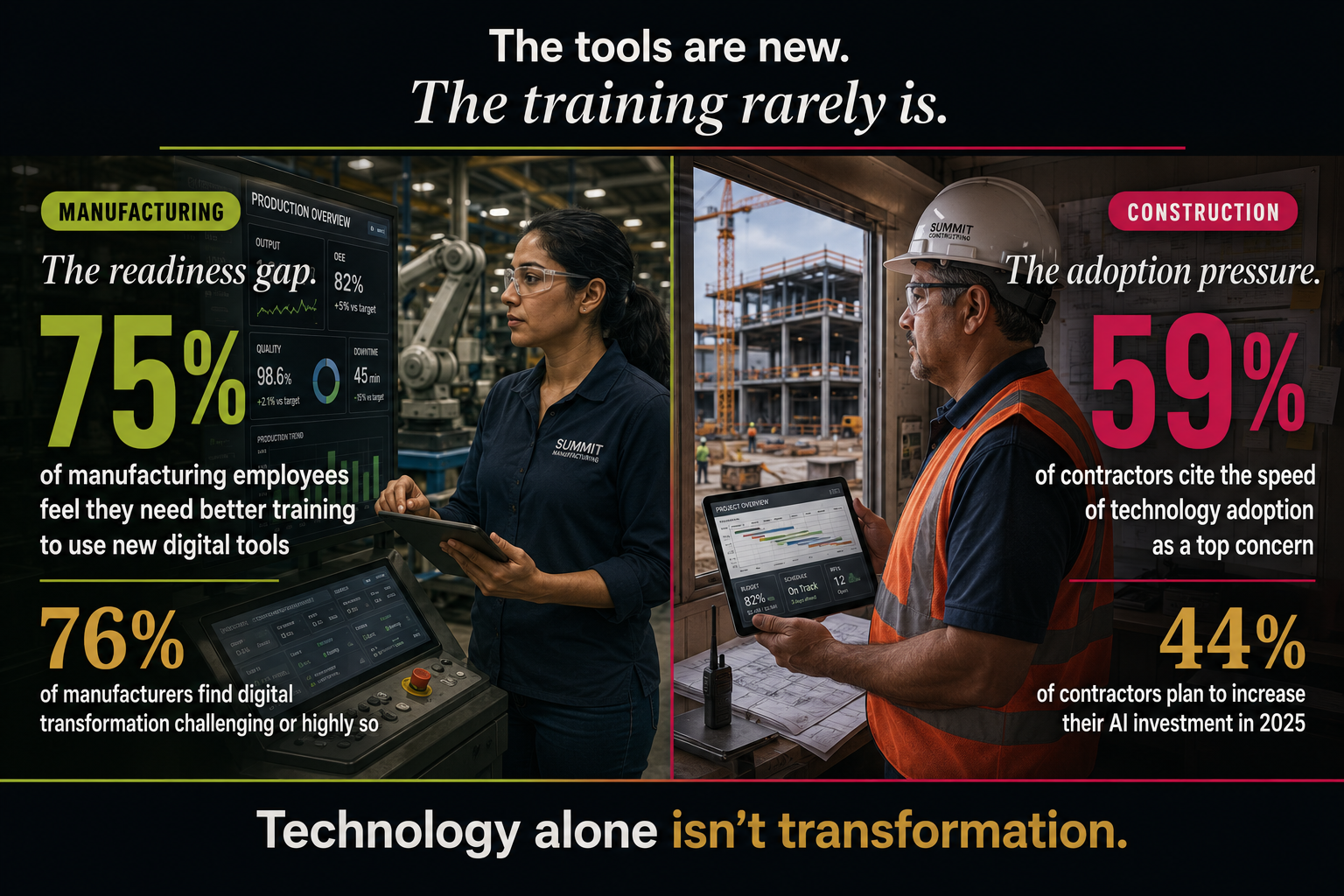
The data is direct. According to research compiled by WifiTalents and Deloitte, 75 percent of manufacturing employees say they need better training to use new digital tools. 76 percent of manufacturing companies report that digital transformation is challenging or highly challenging, driven by legacy machinery, high integration costs, workforce resistance, and stringent regulations. And McKinsey research shows that roughly 70 percent of large scale transformations within organizations fail, a number that has remained remarkably stable even as investment has surged.
In construction, the pattern is similar. According to the 2025 AGC survey, 59 percent of contractors cite the speed of technology adoption as a top concern, and 44 percent plan to increase investment in artificial intelligence this year. The industry has historically lagged behind other sectors in digital adoption, and forecasts suggest the construction industry could lose out on approximately 40 trillion dollars in productivity by 2040 if workforce and productivity growth do not accelerate. The tools are increasingly available. The question is whether the workforce is positioned to make them productive.
The pattern is not that technology fails to deliver. Digital transformation in construction, done well, can produce productivity gains of 14 to 15 percent and cost reductions of 4 to 6 percent, according to McKinsey. Building information modeling, deployed effectively, reduces project timelines by up to 50 percent while cutting costs by more than 50 percent. AI tools have been shown to increase productivity by up to 14 percent in some Stanford and MIT studies. The tools work. The gap is in how they are absorbed by the workforce that has to use them.
That absorption gap is not a technology problem. It is a workforce problem.
When a company invests significantly in technology without a matching investment in workforce readiness, three things tend to happen. First, adoption is uneven. Some teams and individuals embrace the tools and integrate them quickly. Others struggle, resist, or work around them. The result is that the operational benefit shows up in pockets rather than across the enterprise. Second, the workforce splits into two tiers. Employees who feel confident with the new tools become more valuable, more engaged, and often more retained. Employees who feel underprepared become disengaged, less productive, and often more likely to leave. The technology investment inadvertently accelerates the exit of some of the workers the company most needs. Third, the compliance and quality risks grow. Tools used incorrectly are often worse than tools not used at all, particularly in safety critical environments like manufacturing and construction.
The solution is not to slow technology adoption. It is to align workforce strategy with technology strategy from the beginning.
The organizations that are doing this well share a few practices. They treat every significant technology investment as a workforce transformation, not just an IT implementation. They involve frontline workers in the design and rollout of new tools, not only in the training that follows. They train managers first, so that the leaders closest to the work can model and support adoption rather than resist or delegate it. They measure workforce readiness with the same rigor they use to measure system uptime, defect rates, and cost variance. And they make explicit decisions about which workers will be reskilled into new capabilities, which roles will evolve, and which parts of the workforce will need to grow to keep pace with the technology stack.
They also acknowledge a candid reality that most companies avoid. Not every worker adapts to new technology at the same pace, and some do not adapt at all. Companies that want to capture the value of their technology investment have to be willing to invest in retraining where it makes sense, and to make clear decisions about where structural role changes are required. That is difficult work, but it is significantly less expensive than continuing to spend on technology that most of the workforce cannot use.
There is also a strategic implication for hiring. Companies with a strong technology footprint increasingly attract candidates who want to work with modern tools. Candidates in skilled trades, particularly younger workers, evaluate potential employers in part on the quality and modernity of the tools and workflows. A company that has invested in technology and matched it with strong workforce practices signals capability. A company that has invested in technology but left the workforce behind signals dysfunction. In a labor market this tight, that difference shapes who applies and who stays.
At Organa, this is core to how we work with our clients. We help organizations align workforce strategy with the technology transformation already underway, build hiring practices that reflect the modern skill requirements of the industry, and design onboarding and training that turn technology investment into operational advantage. The workforce is where transformation lands, and it is where the value is realized.
Technology alone isn’t transformation. Workforce readiness is. The companies that treat them as one integrated strategy will build durable advantage over the ones that continue to treat them as separate initiatives.
Sources: WifiTalents/Deloitte Manufacturing Digital Transformation Statistics 2026; 2025 AGC Survey; McKinsey Digital Transformation Failure Rate Research; Autodesk State of Digital Adoption in Construction 2025; World Economic Forum Manufacturing Workforce Report 2025; Stanford and MIT AI Productivity Research; StartUs Insights Construction Digital Transformation Report 2025