A common mistake in hiring is treating speed and quality as a tradeoff. Move fast, and you will cut corners. Move carefully, and you will lose the candidate. Neither is true if the underlying process is structured well.
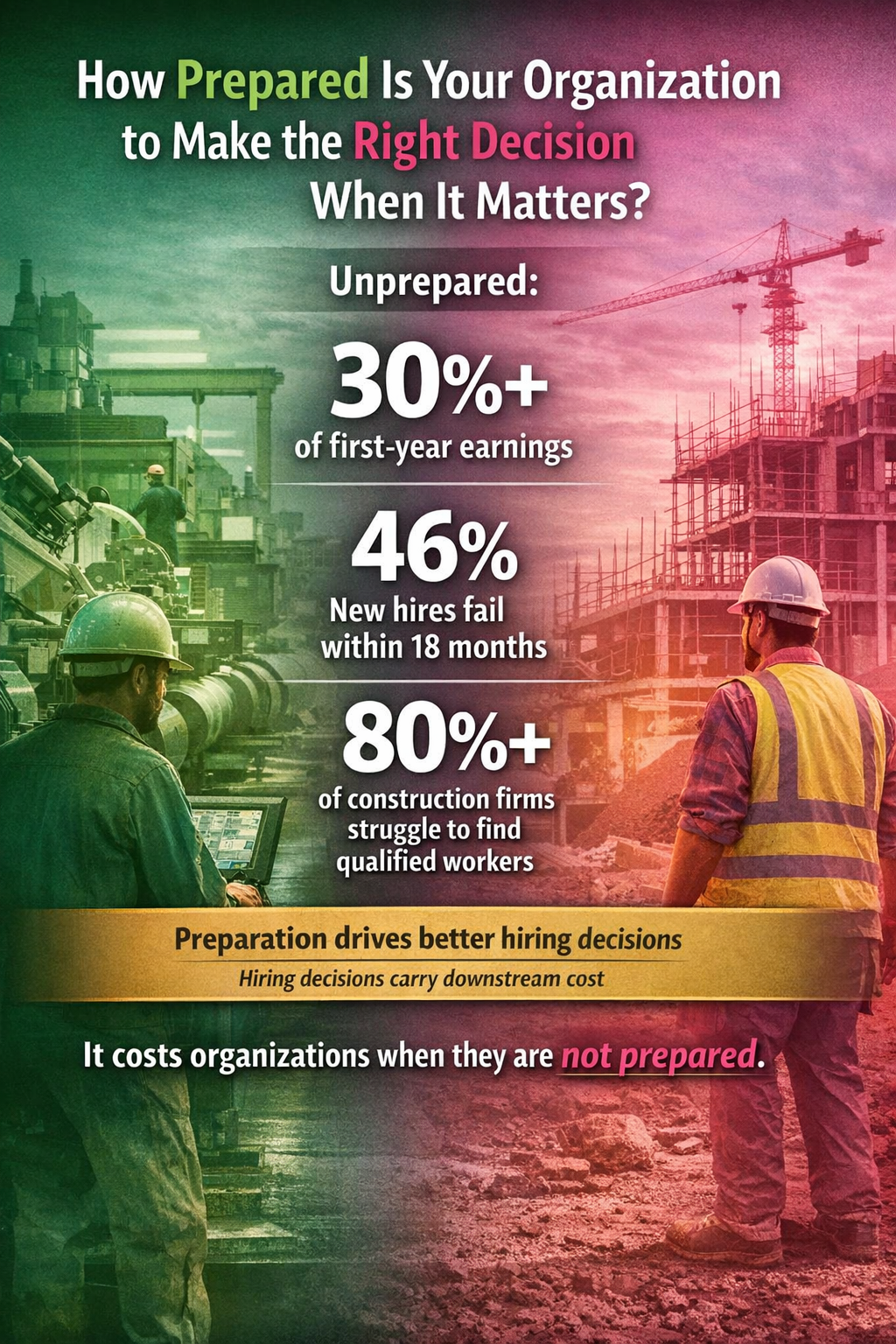
A bad hire can cost up to 30 percent of that employee’s first year earnings, and that estimate does not fully capture the broader impact. Recruiting effort, onboarding time, lost productivity, the strain on the team, and the need to start the process over. At the same time, 46 percent of new hires fail within the first 18 months. Manufacturers continue to cite skills gaps as a primary driver of lost productivity. More than 80 percent of construction firms report difficulty finding qualified workers.
Different industries. Same reality.
The difference between organizations that hire well and those that struggle is not speed. It is preparation.
When roles are clearly defined, when interview teams are aligned on what success looks like, and when hiring processes are structured to support consistent evaluation, decisions can be made quickly with confidence. When that work has not been done in advance, every hiring decision becomes a question of intuition under time pressure.
The cost of a poorly structured process shows up later. In retention. In team performance. In the leader who quietly says, “I knew it was not right, but we needed someone.”
Speed is not the issue. Preparedness is.
Preparing a future ready workforce means doing the work upfront so the moment of decision does not carry all the weight. The organizations that consistently land strong candidates are the ones that have already answered the hardest questions about the role before the first interview begins. They know what excellence looks like. They know what they are willing to compromise on and what they are not. They know who is in the room making the decision and what each person is responsible for evaluating.
At Organa, we work with organizations to strengthen how roles are defined, how candidates are evaluated, and how decisions are made. So leaders can move with both speed and confidence, not one or the other.
The fastest hiring teams are the ones that do not have to rush. They have already done the thinking that lets them act decisively when it matters.
Sources: U.S. Department of Labor; Leadership IQ; Deloitte; Associated General Contractors of America