The numbers around workforce retirement in manufacturing and construction have been discussed for years. What has changed is that the conversation has moved from “this is coming” to “this is happening.”
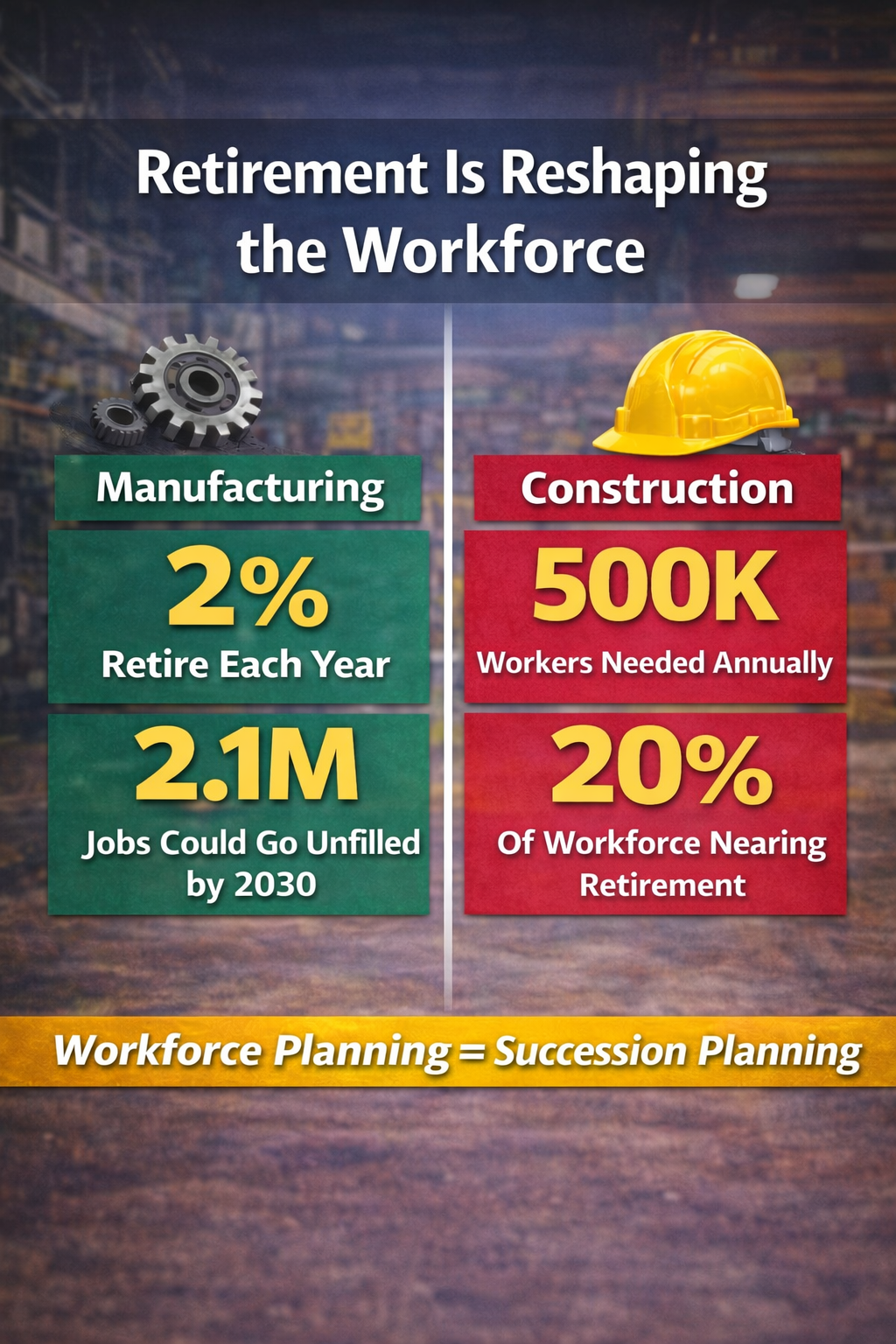
In manufacturing, roughly 2 percent of the workforce retires each year. Compounded across a decade and combined with hiring shortfalls, the industry could face 2.1 million unfilled jobs by 2030. In construction, the numbers tell a similar story from a different angle. The industry needs to attract more than 500,000 workers annually beyond normal hiring just to keep pace with demand. More than 20 percent of the construction workforce is approaching retirement.
When experienced professionals leave, organizations do not just lose headcount. They lose decades of institutional knowledge. They lose the people who know why a particular line behaves the way it does in summer. They lose the supervisors who know which subcontractors deliver and which ones drag. They lose the leaders who hold a team together through a difficult quarter because they have been through six of them.
Different industries. Same reality.
Workforce planning is becoming succession planning. The conversation is not just about how to fill the seat. It is about how to transfer the knowledge that was sitting in it.
The organizations that handle this well are the ones treating it as a multi year leadership initiative rather than a quarterly hiring push. They are building structured knowledge transfer into the months before a key retirement. They are identifying the next generation of leaders earlier, giving them stretch assignments earlier, and creating real mentoring relationships rather than nominal ones. They are investing in their reliability leaders, plant managers, project superintendents, and trade supervisors with the same intentionality they invest in capital projects.
At Organa, we help leaders prepare for these transitions. Not by treating them as departures, but as planned handoffs. The strongest workforce strategies treat experienced professionals as anchors of capability. They build the next generation around them, not around the gap they leave behind.
The retirement wave is not slowing down. The organizations that are preparing for it now are the ones that will still be running strong on the other side.
Sources: The Manufacturing Institute & Deloitte Manufacturing Talent Study; Associated Builders and Contractors Workforce Forecast; McKinsey Manufacturing Workforce Research; U.S. Bureau of Labor Statistics