When most operations leaders talk about workforce risk, they talk about turnover. The annual turnover number gets reviewed in board meetings, watched by HR, and benchmarked against industry data. That is important. It is also incomplete.
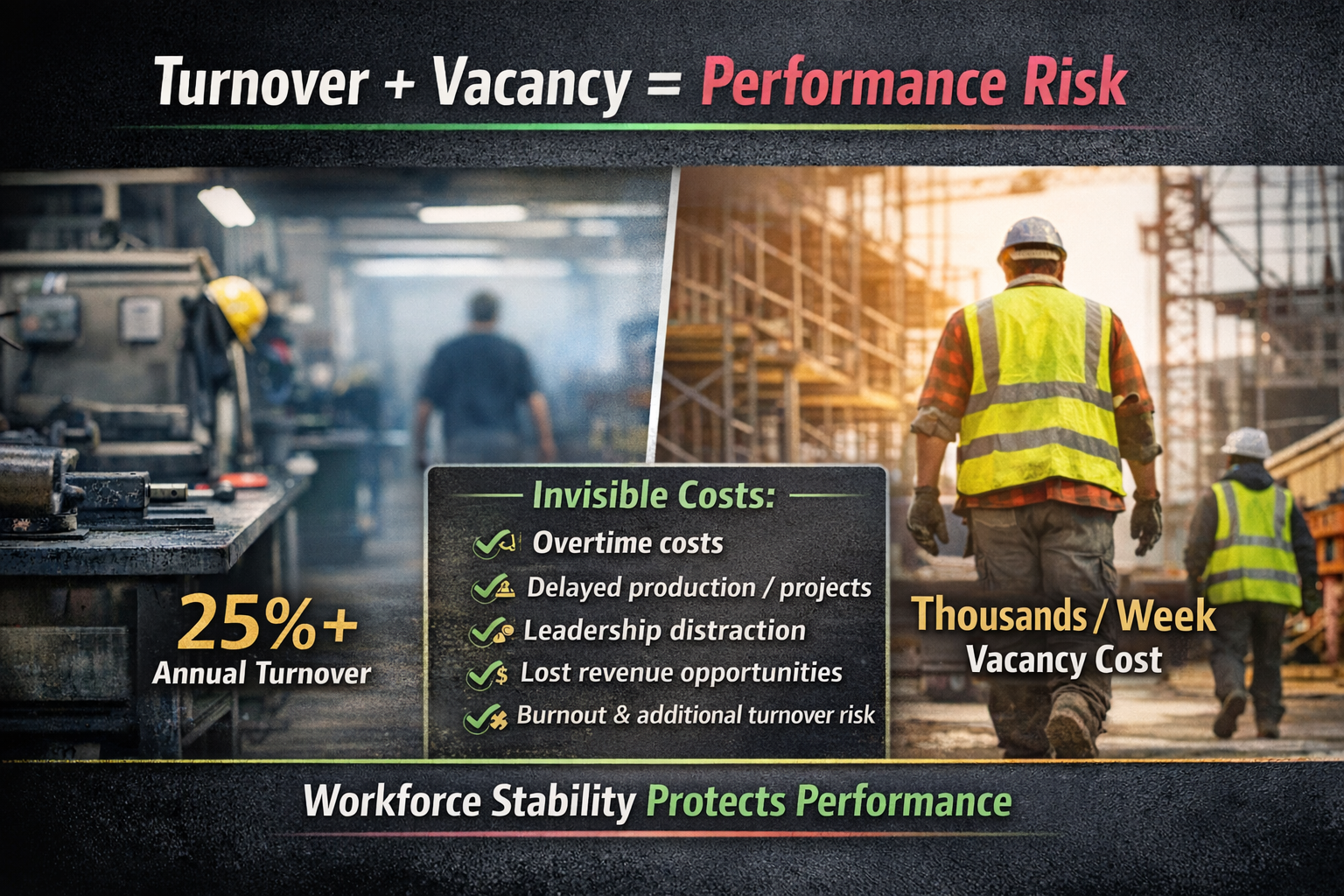
Manufacturing turnover often exceeds 25 percent annually. Construction consistently ranks among the industries with the highest workforce turnover in the country. Those numbers deserve attention. But there is a second risk hiding underneath them, and most organizations do not measure it as carefully.
It is vacancy risk.
Vacancy risk is the cost an organization absorbs while a critical role sits open. Depending on the role, that cost can run into thousands of dollars per week in measurable productivity impact alone. In some operations, the figure is much higher. And the measurable productivity impact is only part of what gets lost.
The invisible costs include the overtime spent covering the gap, the project delays caused by capacity shortfalls, the leadership focus pulled into firefighting, the revenue opportunities that quietly slip past while the organization is short staffed. Add in the burnout that grows on the team carrying the load, and the additional turnover risk that follows, and the true cost of a vacancy often exceeds the direct estimate by a significant margin.
Different industries. Same reality.
Organizations are not just facing turnover risk. They are facing vacancy risk. The two are connected, but they are not the same. You can have low turnover and still bleed performance through chronic vacancies in your most important roles. You can have moderate turnover and protect your operations through fast, disciplined backfills.
Workforce stability is not just an HR metric. It is an operational performance metric.
The leaders who manage both sides of this equation tend to do a few things differently. They identify their critical roles in advance, before anyone leaves. They build pipelines of relationships, not just applicant lists. They treat vacancy duration as a key performance indicator, not just an HR statistic.
At Organa, we work with organizations to reduce both risks at once. Hiring well, holding the team together, and shortening the time critical seats stay empty. The strongest operations are the ones that take both seriously.
Sources: U.S. Bureau of Labor Statistics (JOLTS Industry Turnover Data); SHRM and workforce cost of vacancy research