
The workforce that already trained for the job
The workforce that already trained for the job
Manufacturing and construction continue to navigate some of the toughest labor shortages in the country. The conversation often focuses on where future talent will come from. The data points to a workforce that is already trained, already available, and already underused.
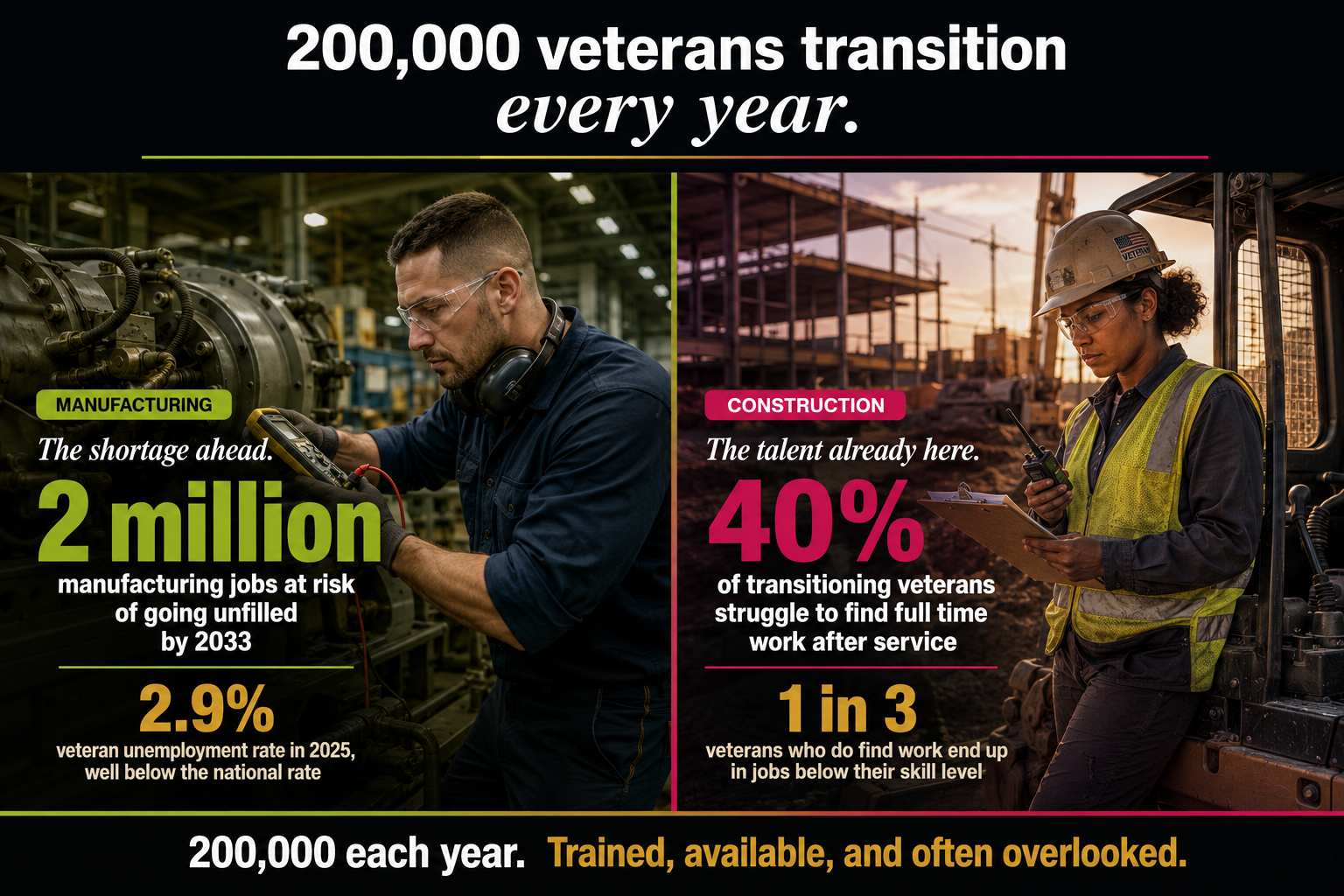
Approximately 200,000 service members transition out of the military every year. Their training includes the disciplines manufacturing and construction depend on most. Mechanical and equipment operations. Safety culture. Logistics. Leadership under pressure. Accountability for outcomes. These are not skills that need to be developed from scratch. They are already there.
Despite that alignment, 40 percent of veterans struggle to find full time employment after their service ends. About 1 in 3 who do find work end up in jobs below their skill level. Meanwhile, nearly 2 million manufacturing jobs are at risk of going unfilled by 2033 if current talent gaps are not addressed. Two populations are arriving at the same problem from opposite sides, and the workforce strategy that connects them remains underdeveloped in most organizations.
The issue is rarely about ability. Military training produces some of the most operationally capable workers in the country, and the veteran unemployment rate in 2025 sat at 2.9 percent, well below the rate for nonveterans. The issue is translation.
Civilian job descriptions are written in civilian language. Military experience does not always map cleanly to the resume formats and credential filters most hiring processes are built around. A Marine Corps logistics specialist who managed multi million dollar inventories under combat conditions may not look like a “warehouse manager” on paper. A Navy machinist mate who maintained ship propulsion systems may not appear to meet the requirements for a manufacturing maintenance role, even though the underlying work is closely aligned. Without deliberate effort to bridge that gap, capable candidates get screened out before anyone has the chance to evaluate them.
The organizations that have built veteran hiring into their workforce strategy tend to share a few characteristics. They partner with the Department of Defense SkillBridge initiative, which connects transitioning service members with civilian employers in their final 180 days of service, giving organizations a no cost way to evaluate fit before formal hiring. They train hiring managers to translate military roles into job relevant skills, often using tools developed by the Manufacturing Institute and similar organizations. They build relationships with veteran focused trade schools and apprenticeship programs. And they
treat veteran hiring as a recruiting strategy with measurable outcomes, not a one time gesture timed to a holiday.
There is also a retention story embedded in this. Veterans tend to bring habits that translate directly into workforce stability. They show up on time. They follow process. They work well in teams. They handle pressure without escalating it. In environments where turnover is a daily operational risk, those characteristics carry quantifiable value. The signal in the 2025 hiring data is that skilled labor and trades entered the top ten job functions for veteran hires for the first time, suggesting that the alignment is starting to be recognized, even if most recruiting strategies have not caught up.
The workforce strategy implication is straightforward. Manufacturing and construction face a structural labor shortage. The veteran population represents one of the most aligned and underutilized talent pools available, and the organizations that build deliberate pathways to access it will have an advantage over those that do not.
At Organa, this is the work we lead alongside our clients. We help organizations build hiring practices that translate non traditional experience into capability, develop relationships with veteran focused training and transition programs, and create pathways that connect skilled candidates to the roles they are ready for.
200,000 each year. Trained, available, and often overlooked. The recruiting strategy that recognizes that is the one that solves the problem.
Sources: U.S. Bureau of Labor Statistics; Wounded Warrior Project Employment Study; Hire Heroes USA Top Jobs for Veterans 2025; The Manufacturing Institute Workforce Outlook; Center for Regional Economic Competitiveness Mission Ready Workforce Report; Department of Defense SkillBridge Program