
Why your exit interview data may be solving the wrong problem
Why your exit interview data may be solving the wrong problem
Exit interviews are one of the most relied on data sources in workforce strategy. They are also one of the most misleading.
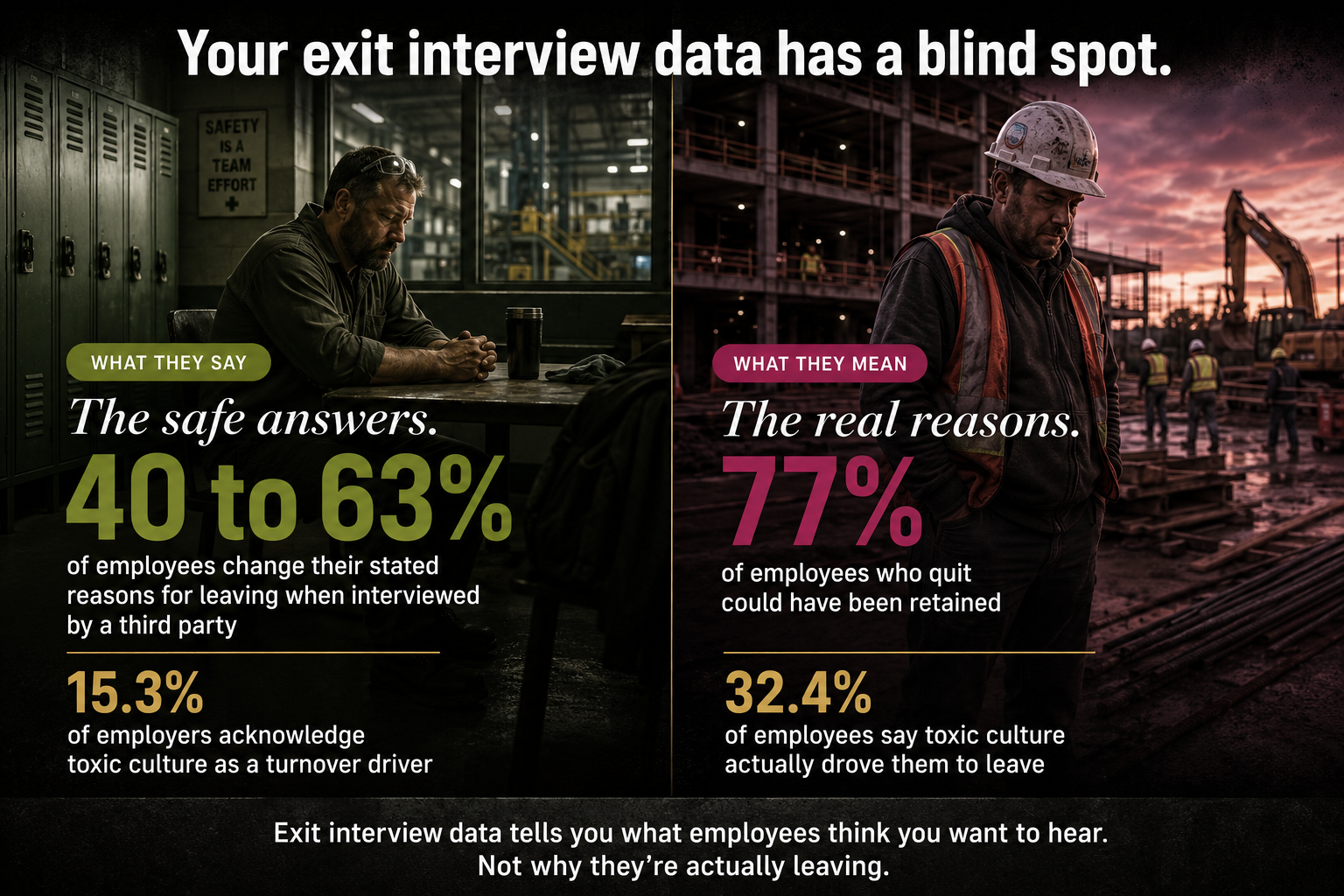
The pattern shows up in the research consistently. When employees are interviewed by their own company, between 40 and 63 percent change their stated reasons for leaving once they are later interviewed by a confidential third party. The reasons that get logged in the system are not always the reasons that drove the decision.
This is not a failure of HR teams or of the people conducting the interviews. It is a function of the conversation itself. Departing employees are calibrating their answers to what feels safe to say. They are protecting future references, preserving relationships, and avoiding burning bridges on the way out. The result is that the safest reasons get recorded. Better opportunity. Shorter commute. More money. The deeper reasons, the ones that actually drove the decision, often go unsaid.
The data that supports this pattern is significant. SHRM research indicates that 77 percent of employees who quit could have been retained. The Work Institute, drawing on more than 120,000 exit interviews collected from 2020 through 2025, found that nearly 75 percent of all turnover is preventable. And the perception gap between employees and employers is wide: 32.4 percent of employees report that toxic work environments drove them to leave, while only 15.3 percent of employers acknowledge culture as a turnover driver.
The cost of this gap is operational. When retention strategies are built on data that captures the safe answer rather than the real answer, organizations end up solving for the wrong problem. More flexibility programs do not fix a manager issue. Higher pay does not fix a career growth issue. Better benefits do not fix a culture issue. The investment is real, the effort is sincere, and the result is that the underlying driver of turnover continues to operate unaddressed.
What we see in our work with manufacturing and construction leaders is that the most effective retention programs are built on a wider set of inputs than the exit interview alone. They include stay interviews conducted by direct managers as part of regular practice, not as a one time intervention. They build confidential feedback pathways that allow employees to surface concerns without putting their standing at risk. They connect workforce data to the operational decisions that actually shape retention, including how managers are selected, trained, and supported. And they treat the exit interview as one signal among many, rather than the definitive record of why someone left.
Retention is not a perks problem. It is a diagnostic problem. The organizations that get it right are the ones that build systems to hear what employees mean, not just what they say.
At Organa, this is the work we lead alongside our clients. We help organizations redesign how they listen across the employee lifecycle, build the management practices that surface real signal before it becomes attrition, and connect retention data to the decisions that actually move the number.
Exit interview data tells you what employees think you want to hear. It rarely tells you why they are actually leaving. Closing that gap is one of the highest leverage moves a leader can make.
Sources: Work Institute 2025 Retention Report (120,000 exit interviews 2020 to 2025); SHRM Exit Interview Research; Gallup State of the Global Workplace 2025; Science of People Exit Interview Research