
The workforce has been telling us where the talent is
The workforce has been telling us where the talent is
For years, manufacturing and construction have been working through some of the toughest labor shortages we have seen. The conversation tends to focus on what is missing. The pipeline that is not big enough. The schools that are not producing enough graduates. The applicants who are not showing up. All of it is true. And all of it leaves out a piece of the story that most workforce planning conversations are not pulling forward.
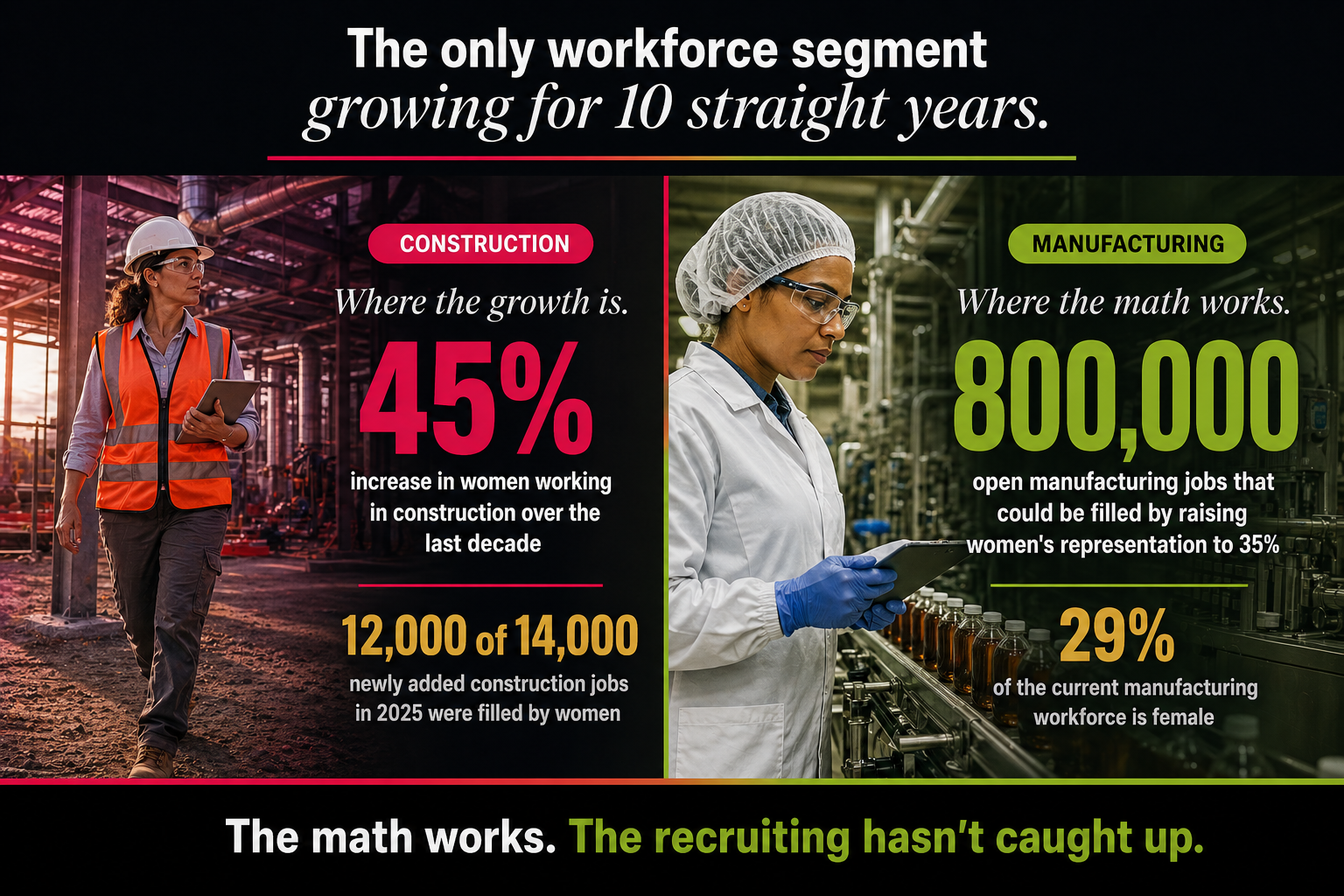
There is one segment of the workforce that has grown consistently for ten straight years across both industries. Women. The data is clear, and the trend is steady. The recruiting strategies just have not pivoted to reflect it.
Look at construction first. The number of women in the industry has grown 45 percent over the last decade, from 939,000 in 2016 to 1.36 million in 2025. Women now represent 11.2 percent of the construction workforce, the highest share in 20 years. Most striking, in 2025, women filled 12,000 of the 14,000 newly added construction jobs. Even as the industry experienced overall slowdowns, women were the population still entering the field.
The picture in manufacturing is similar in shape but larger in scale. Women currently make up roughly 29 percent of the manufacturing workforce. The Manufacturing Institute has set a target of raising that share to 35 percent by 2030, an initiative known as 35x30. If the industry hits that target, it would add an estimated 800,000 workers, nearly enough to fill every open manufacturing job in the country.
Read that again. The labor shortage in manufacturing could be substantially closed by recruiting to a population already working in the industry, just at lower representation than the workforce overall.
The data tells us where the growth is. The question is whether organizations are positioned to capture it.
In our work with manufacturing and construction leaders, we see the same pattern repeatedly. The companies struggling most with workforce shortages are usually running the same recruiting playbook they ran ten years ago. The job descriptions are the same. The sourcing channels are the same. The interview practices are the same. The retention programs are the same. And then the leaders wonder why the talent is not showing up.
The companies expanding their workforce reliably look different. They have rewritten job descriptions to remove physical and credential requirements that are not actually necessary
for the work. They have built relationships with apprenticeship programs, community colleges, and trade organizations that are specifically focused on bringing women into the field. They have addressed the practical barriers that drive attrition once women are hired, including scheduling flexibility, facilities, and the day to day culture of the team. None of this is complicated. All of it requires deliberate design.
The labor shortage in manufacturing and construction is real, and it is not going away. The question for leaders is not whether women represent part of the solution. The data has already answered that. The question is whether the organization is willing to redesign its recruiting and retention strategy to reflect what the workforce is already telling them.
At Organa, this is the work we lead alongside our clients. We help organizations align their recruiting strategy with where the workforce is actually growing, build inclusive hiring practices that hold up to the realities of skilled trades and shop floor work, and develop retention programs that protect the investment once people are hired.
The math works. The recruiting just has to catch up.
Sources: National Association of Home Builders; Bureau of Labor Statistics Current Population Survey; The Manufacturing Institute Gender Diversity Study (35x30 Initiative); ABC Carolinas Workforce Analysis 2026; Fixr.com Women in Construction Week 2026