The conversation about workforce shortages is often framed as a supply problem. There are not enough people. There are not enough skilled trades. There are not enough qualified candidates. Some of that is true. But the data points to a quieter contributor that does not get enough attention. The candidates we are filtering out before we ever evaluate them.
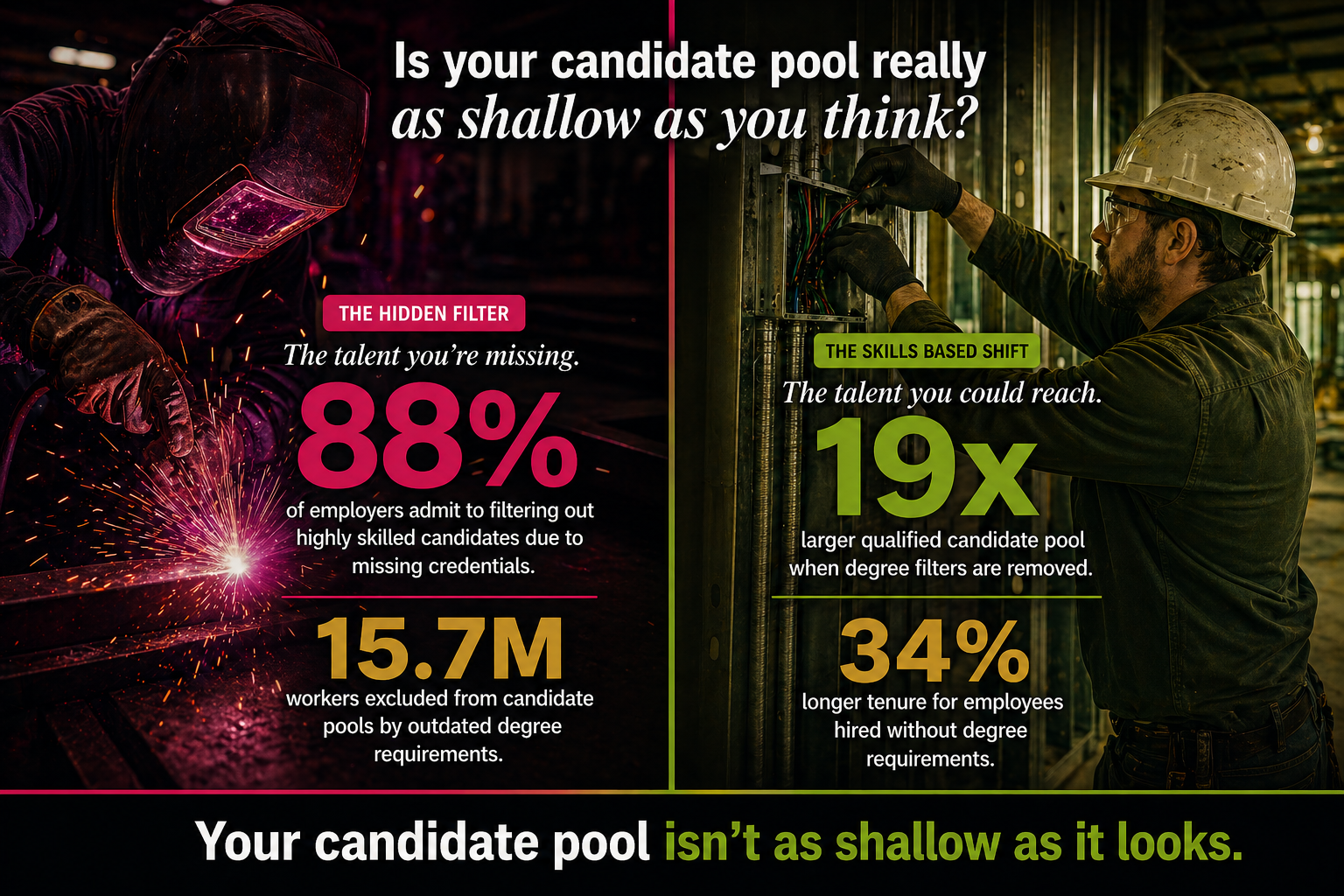
Eighty eight percent of employers admit they screen out highly skilled candidates because of missing credentials, often degrees or specific job titles. Roughly 15.7 million workers are excluded from candidate pools because 37 percent of middle skill jobs still require a degree. When U.S. companies remove degree filters and evaluate candidates based on actual skills, the qualified talent pool grows nearly 19 times. Eighty five percent of U.S. employers now use skills based hiring, up from 57 percent in 2022. And employees hired without degree requirements stay 34 percent longer than those hired with them.
Different industries. Same expanding pool.
For decades, degree requirements and credential filters served as a shorthand for capability. In skilled trades, advanced manufacturing, and operations leadership, that shorthand has not always reflected what the work actually requires. Capable candidates with hands on experience, certifications, apprenticeships, and demonstrated skill are routinely screened out before they are ever evaluated.
Skills based hiring is not about lowering standards. It is about measuring the right ones.
The shift requires more than removing a checkbox from the job posting. It requires designing assessments that measure the abilities the role actually demands. It requires interview teams who can evaluate technical capability rather than relying on resume signals. It requires hiring managers willing to consider candidates whose paths do not look like the paths of the people already on the team.
For manufacturers and construction leaders, this shift is one of the most direct ways to expand the pool without compromising on quality. The workers exist. They are just being filtered out by criteria that may not predict performance in the role.
At Organa, we work with organizations to align hiring criteria with the actual demands of the role. To build skills based assessments into the interview process. To widen the funnel without compromising the bar.
Your candidate pool is not as shallow as it looks. Most organizations are building taller walls around their hiring than they realize. The ones who recognize that, and who adjust accordingly, are the ones discovering that the talent they need has been there all along.
Sources: Harvard Business School Hidden Workers research; Burning Glass Institute; LinkedIn Economic Graph; TestGorilla State of Skills Based Hiring 2025; LinkedIn Talent Solutions