
The pipeline hiding in plain sight
This is a subtitle for your new post
Most workforce strategies focus on where to find talent. Job boards. Recruiting agencies. Employer branding campaigns. Trade schools. Apprenticeship partnerships. All useful. All worth investing in. And all of them tend to overlook the hiring channel that consistently outperforms every other option on cost, speed, quality, and retention.
Employee referrals.
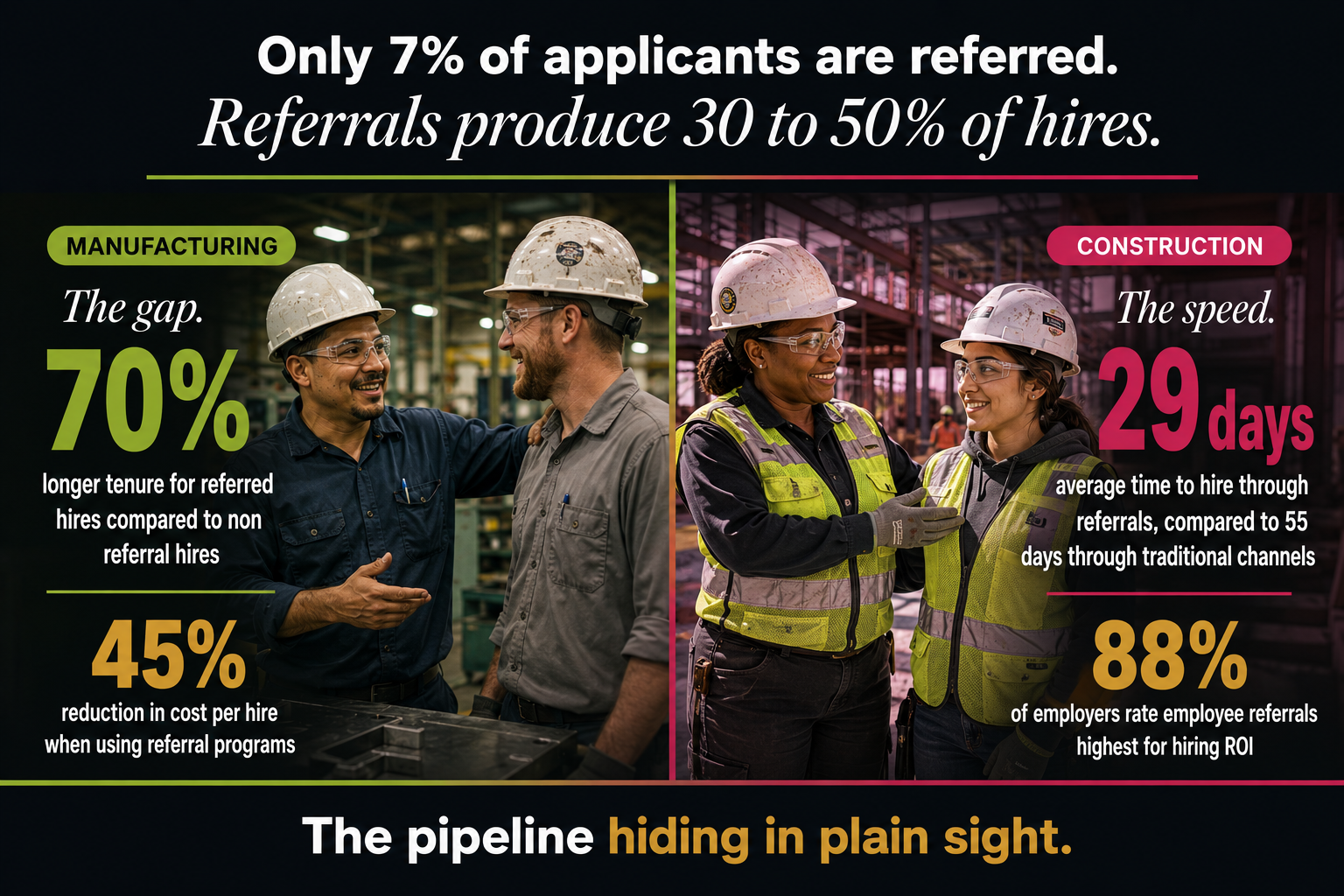
The data on referral hiring is difficult to argue with. Only about 7 percent of applicants come through referrals, but those referrals account for 30 to 50 percent of all new hires across most industries. Referred candidates are four times more likely to get hired than candidates from other sources. Referred hires reach full productivity 55 percent faster than non referral hires, with an average time to hire of 29 days compared to 55 days for traditional channels. And once hired, they stay significantly longer.
According to research compiled by ERIN and Sci Tech Today, referred employees stay 70 percent longer in their roles than non referral hires. The retention rate for referred employees is 46 percent, compared to 33 percent for job board hires. Nearly half of referred employees stay with their employer for more than four years, while only about a quarter of job board hires stay past two. Referral hires reduce cost per hire by up to 45 percent, and 88 percent of employers rate referrals as the highest ROI hiring channel available.
These are not marginal improvements. They are structurally different outcomes.
The pattern is especially pronounced in manufacturing and construction. According to the 2025 SHRM Talent Trends report, employers in the manufacturing, construction, and utilities industries reported significantly higher reliance on employee referrals to generate their talent pipeline compared to most other industries. The reason makes intuitive sense. Skilled trades are relational fields. Reputation carries weight. When someone on the floor or on the crew vouches for a candidate, that endorsement functions as a form of pre screening that no job posting can replicate.
Despite that, most companies still underinvest in referral programs. 84 percent of companies technically have a referral program in place. Very few maximize what those programs are capable of producing. Bonus amounts often lag industry benchmarks. Programs are inconsistently promoted. Referral pathways are hard to use. And the connection between referrals and workforce strategy is rarely made explicit in leadership conversations, even though the data supports investing in referrals as one of the most reliable levers a company can pull.
There is also an underappreciated dynamic worth naming. According to industry research, only 6 percent of employees refer candidates solely for financial rewards. 35 percent refer specifically because they want to help their friends. Employees make referrals because they believe in their workplace, and because they believe their referral will have a positive experience. This means the strength of a referral program is a direct signal of the strength of the employee experience. Companies with weak internal culture, poor onboarding, and disengaged workers rarely generate strong referral pipelines. Companies with strong culture and engaged workers often generate them without much effort.
The pattern we see in our work with manufacturing and construction leaders is consistent. The organizations that get referrals right tend to do a few things well. They pay competitive bonuses that reflect the actual value of a referred hire, which for skilled trades often means bonuses in the $2,000 to $5,000 range rather than the $500 to $1,000 that some companies default to. They make it easy to refer, with simple submission tools and clear tracking so employees know the status of their referrals. They pay bonuses at multiple stages, including on hire and after retention milestones, which incentivizes quality referrals rather than volume. They communicate open roles internally in a way that reaches employees on the floor, not just those checking email. And they connect the referral program to broader employee engagement, so that the culture is strong enough to make referrals feel worth making.
They also measure the results. Referral rate, time to hire, retention, and performance of referred hires. Without measurement, referral programs quietly drift into ceremony. With measurement, they become one of the most predictable workforce strategy tools available.
The strategic implication is straightforward. Manufacturing and construction are facing structural labor shortages, rising replacement costs, and increasing competition for skilled talent. Employee referrals are the hiring channel most likely to deliver on all three fronts, and they are already partially built inside most organizations. The companies that invest in strengthening what is already there will reap disproportionate benefit compared to those that continue treating referrals as a passive supplement to external recruiting.
At Organa, this is the work we lead alongside our clients. We help organizations audit and redesign their referral programs to reflect the realities of skilled trades hiring, connect referral incentives to retention and performance outcomes, and build the cultural conditions that make referral programs actually work.
The pipeline hiding in plain sight is the one most companies already own. The question is whether the strategy is built to use it.
Sources: ERIN Employee Referral Statistics 2025; Sci Tech Today Referral Statistics Report; Apollo Technical Referral Statistics 2026; SHRM 2025 Talent Trends Recruiting Report; Boon Employee Referral Research; MokaHR Referral Program Effectiveness Analysis 2025