
The workforce runs on managers. Most managers are running on empty.
This is a subtitle for your new post
When most companies think about retention, the conversation focuses on compensation, culture, and career development. All of that matters. But the data points to something more specific and more actionable than any of those levers.
The single biggest predictor of whether an employee stays or leaves is the manager they report to. And in most organizations, the manager is the one workforce lever companies underinvest in the most.
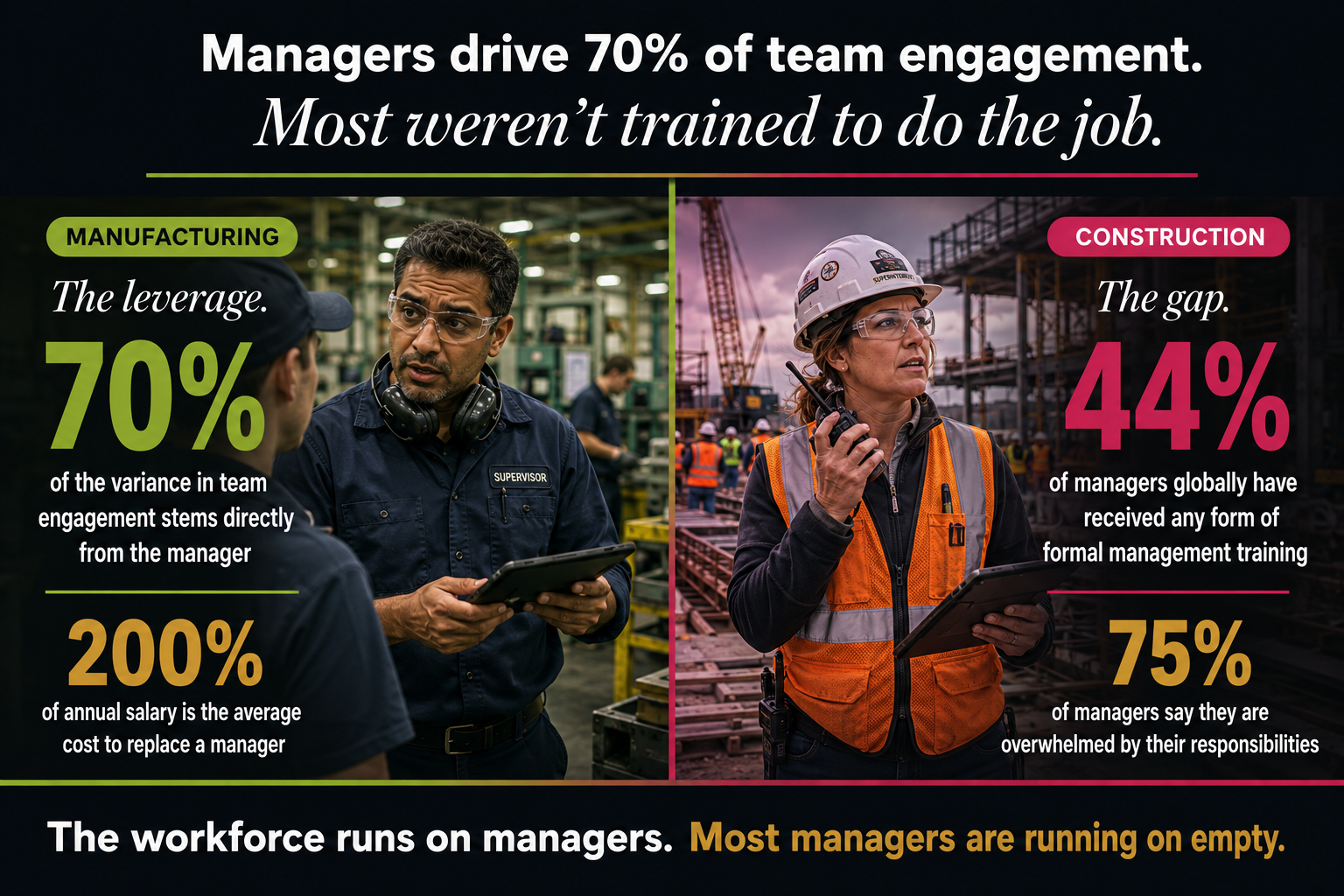
Gallup research has consistently found that managers account for 70 percent of the variance in team engagement. Every retention strategy, every culture initiative, every attempt to reduce turnover ultimately runs through the frontline manager. When managers are engaged and supported, teams follow. When managers are burned out, disengaged, or unprepared, the effects ripple through everything else. Employees do not leave companies. They leave managers, or the conditions that a manager either creates or fails to prevent.
The 2025 and 2026 Gallup State of the Global Workplace reports paint a difficult picture. Manager engagement has dropped nine points since 2022, falling from 30 percent to 22 percent in 2026. The steepest single year decline came between 2024 and 2025, when manager engagement fell five points in a single year. Only 44 percent of managers globally have received any form of formal management training. Untrained managers are twice as likely to be actively disengaged as their trained counterparts. Gartner reports that 75 percent of managers say they are overwhelmed by their responsibilities. Global disengagement cost the world economy an estimated 10 trillion dollars in lost productivity in 2024 alone.
The situation is especially acute for frontline managers in manufacturing and construction. These are the shift supervisors, foremen, superintendents, and floor leads who translate strategic goals into daily execution. They set the pace of work. They resolve friction in real time. They own the communication, feedback, and recognition that determine whether an employee feels supported or invisible. And in most companies, they are promoted into the role without meaningful training, expected to figure it out on their own, and then held accountable for outcomes they were never equipped to produce.
This is not a personal failure. It is a system failure with predictable consequences.
There is a connection worth drawing to earlier posts in this series. The exit interview blind spot showed that 40 to 63 percent of employees change their stated reasons for leaving when interviewed by a confidential third party, and Gallup data consistently shows that a significant share of voluntary exits trace back to the manager relationship rather than to compensation or benefits. The first 90 days post showed that early attrition often reflects a mismatch between expectations and reality, and that Gallup data attributes 70 percent of team engagement variance to the manager. Stay interviews work in large part because they are conducted by managers, when done well. Internal mobility depends on managers who develop rather than hoard talent. Nearly every workforce strategy conversation eventually returns to the same lever.
The strategic implication is that improving manager capability may be the single highest ROI investment a company can make in its workforce. The evidence supports this at scale. One organization documented by Gallup reduced attrition by more than half, from 27 percent to 12 percent, by focusing specifically on manager and employee relationships and giving frontline leaders ownership over retention. Similar patterns show up across industries where manager development has been prioritized. Companies with strong manager development programs see measurable improvements in retention, engagement, safety, productivity, and quality.
None of this requires exotic programs or transformative culture change. It requires deliberate investment in a few core practices. Selecting managers based on aptitude for leadership rather than technical expertise alone. Providing formal training in the fundamentals of the role, including feedback, coaching, conflict resolution, and delegation. Building peer learning networks so that managers have somewhere to bring problems and refine their approach.
Measuring manager effectiveness with the same rigor applied to other operational metrics. And creating the conditions in which managers can actually do the job, including manageable spans of control, clear expectations, and the authority to make decisions that affect their teams.
There is also a candid observation worth making. Manufacturing and construction leaders often invest significantly in equipment, safety programs, and process improvement. Those investments deliver measurable returns. But the investment in the people who lead the teams that operate the equipment, follow the safety programs, and execute the processes is often a fraction of what is spent on the systems themselves. Rebalancing that investment is not sentimental. It is strategic.
At Organa, this is the work we lead alongside our clients. We help organizations design manager selection criteria that identify leadership potential rather than technical performance alone, build training programs tailored to the realities of frontline management in skilled trades and shop floor work, and create the accountability systems that turn manager development into measurable workforce outcomes.
The workforce runs on managers. Most managers are running on empty. Closing that gap is one of the most consequential moves a leader can make.
Sources: Gallup State of the Global Workplace 2025 and 2026 Reports; Gartner Manager Overwhelm Research; SHRM 2025 Talent Trends Report; CoAdvantage Manager Effect Retention Study; Achievers Workforce Institute Employee Engagement Research; Forbes Management Engagement Crisis Analysis 2026